visit
Load a URL in the application under test. cy.visit() waits for the page to
fire its load event, then yields the page's window object.
We recommend setting a baseUrl when using cy.visit(). See
Setting a global baseUrl.
Syntax
cy.visit(url)
cy.visit(url, options)
cy.visit(options)
Usage
Correct Usage
cy.visit('/') // visits the baseUrl
cy.visit('index.html') // visits a local file when baseUrl is null
cy.visit('http://localhost:3000') // full URL: no baseUrl, or another host
cy.visit({
  url: '/pages/hello.html',
  method: 'GET',
})
Arguments
url (String)
The URL to visit.
When baseUrl is set, Cypress prefixes the URL with it. Without a baseUrl,
provide a fully qualified URL, or Cypress serves the path as a local file. See
how cy.visit() prefixes URLs with baseUrl.
Visiting a new origin reloads the Cypress window. To visit a different origin
in the same test, use cy.origin(), even when the
origins share a superdomain (unless
injectDocumentDomain is
enabled).
options (Object)
Pass in an options object to control the behavior of cy.visit().
| Option | Default | Description |
|---|---|---|
url | null | The URL to visit. Cypress appends it to the baseUrl if one is configured. Behaves the same as the url argument. |
method | GET | The HTTP method to use in the visit. Can be GET or POST. |
body | null | An optional body to send with a POST request. A string is sent unmodified. An object is URL encoded and sent with a Content-Type: application/x-www-form-urlencoded header. |
headers | {} | An object that maps HTTP header names to values to send with the request. Cypress sends headers only with the initial cy.visit() request, not with any later requests. |
qs | null | Query parameters to append to the url of the request. Must be an object. |
log | true | Displays the command in the Command Log. |
auth | null | Adds Basic Authorization headers. |
failOnStatusCode | true | Whether to fail on response codes other than 2xx and 3xx. |
onBeforeLoad | none | Called before your page has loaded all of its resources. |
onLoad | none | Called once your page has fired its load event. |
retryOnStatusCodeFailure | false | Whether Cypress retries the request when the status code is outside 2xx and 3xx. When true, Cypress retries up to 4 times. Requires failOnStatusCode to be true. |
retryOnNetworkFailure | true | Whether Cypress retries the request after a transient network error. When true, Cypress retries up to 4 times. |
timeout | pageLoadTimeout | Time to wait for cy.visit() to resolve before timing out. The request for the page can still time out sooner, at responseTimeout or the operating system's network limit. |
To change pageLoadTimeout and baseUrl for every cy.visit(), set them in
your Cypress configuration.
Yields
cy.visit()yields thewindowobject after the page finishes loading.- It is unsafe
to chain further commands that rely on the yielded
windowaftercy.visit().
This example confirms window.navigator.language after visiting the site:
cy.visit('/') // yields the window object
  .its('navigator.language') // yields window.navigator.language
  .should('equal', 'en-US') // asserts the expected value
To work with the window directly, use .then():
cy.visit('index.html').then((contentWindow) => {
  // contentWindow is the remote page's window object
})
Examples
URL
Visit a local server running on http://localhost:8000
cy.visit() resolves when the remote page fires its load event.
cy.visit('http://localhost:8000')
Options
Change the cy.visit() page load timeout
The timeout option overrides the pageLoadTimeout from your
configuration for this page load.
// Wait 30 seconds for page 'load' event
cy.visit('/index.html', { timeout: 30000 })
Add basic auth headers to cy.visit()
When your application uses Basic Authentication, Cypress can send the credentials for you.
Provide the username and password in the auth object. Cypress then
attaches them at the network level to every later request to the origin you're
testing. Pass log: false to leave the visit out of the Command Log. Without it,
clicking the visit row prints the auth object, password included, to the
console. Keep in mind that log: false also hides the visit's URL and redirects,
which you'd otherwise use when debugging a failed visit.
cy.visit('https://example.cypress.io/', {
  auth: {
    username: 'wile',
    password: 'coyote',
  },
  log: false,
})
You can also provide the username and password directly in the URL. In this
form, the Command Log row shows the full URL, password included, so log: false
matters even more: without it, the password appears in screenshots and videos
of the run.
// this is the same thing as providing the auth object
cy.visit('https://wile:coyote@example.cypress.io', { log: false })
Cypress attaches the Authorization header for you on requests to the origin
you visited. Other origins do not receive it. On the
legacy network path
the header is attached outside of the browser, so it does not appear in
DevTools.
Run code before the page loads with onBeforeLoad
Cypress calls onBeforeLoad as early as possible, before your page has loaded
all of its resources. Your app's scripts haven't run yet, so this is the place
to prepare the page before your app starts.
This example seeds a token in localStorage before the app reads it, and stubs
window.open so the test can assert on it:
cy.visit('/#dashboard', {
  onBeforeLoad(win) {
    // win is the remote page's window object
    win.localStorage.setItem('token', 'abc123')
    cy.stub(win, 'open').as('windowOpen')
  },
})
cy.get('@windowOpen').should('not.have.been.called')
These recipes use the onBeforeLoad option to:
Run code after the page loads with onLoad
Cypress calls onLoad once your page has fired its load event. At this point,
all of the page's scripts, stylesheets, HTML, and other resources are available.
cy.visit('/#/users', {
  onLoad: (contentWindow) => {
    // contentWindow is the remote page's window object
    if (contentWindow.angular) {
      // do something
    }
  },
})
Add query parameters to a cy.visit() URL
Pass query parameters as an object in the qs option.
// visits <baseUrl>/users?page=1&role=admin
cy.visit('/users', {
  qs: {
    page: '1',
    role: 'admin',
  },
})
Cypress merges the parameters in qs into any query parameters already on the
url.
// visits https://example.cypress.io/users?page=1&admin=true
cy.visit('https://example.cypress.io/users?page=1', {
  qs: { admin: true },
})
Submit a form with a cy.visit() POST request
To send a request that looks like a user submitting an HTML form, use a POST
method with a body containing the form values:
cy.visit({
  url: '/cgi-bin/newsletterSignup',
  method: 'POST',
  body: {
    name: 'Avery Quinlan',
    email: 'avery.quinlan@example.com',
  },
})
Send custom request headers with cy.visit()
Pass headers to send extra HTTP headers with the page request, such as a
language preference or a feature flag your server reads. Cypress sends them
only with the initial cy.visit() request, not with the requests the page
makes afterward.
cy.visit('/', {
  headers: { 'Accept-Language': 'fr-FR' },
})
cy.contains('Bienvenue')
Visit an error page with failOnStatusCode: false
By default, cy.visit() fails when the server responds with a status code
outside the 2xx and 3xx ranges. To test your 404 or 500 page, set
failOnStatusCode to false and assert on what the page shows:
cy.visit('/does-not-exist', { failOnStatusCode: false })
cy.contains('h1', 'Page not found')
Retry cy.visit() while your server finishes starting
When your server answers with an error status for a few seconds after it
starts, such as a 503 in CI, set retryOnStatusCodeFailure to true.
Cypress retries the request up to 4 times before failing.
cy.visit('/', { retryOnStatusCodeFailure: true })
Workflows
Log in once with cy.session() and visit in each test
Pair cy.visit() with cy.session() to log in once,
cache the session, and restore it before each test. Call cy.visit() after
cy.session(), since Cypress clears the page each time it restores a session.
beforeEach(() => {
  cy.session('user', () => {
    cy.visit('/login')
    cy.get('#username').type('user')
    cy.get('#password').type('s3cret', { log: false })
    cy.get('form').submit()
    cy.location('pathname').should('eq', '/dashboard')
  })
  cy.visit('/dashboard')
})
Notes
How cy.visit() prefixes URLs with baseUrl
When baseUrl is set, Cypress prefixes the URL with it. Configure baseUrl in
the Cypress configuration so you don't repeat
the host in every cy.visit() command.
- cypress.config.js
- cypress.config.ts
const { defineConfig } = require('cypress')

module.exports = defineConfig({
  e2e: {
    baseUrl: 'http://localhost:3000/#/',
  },
})
import { defineConfig } from 'cypress'

export default defineConfig({
  e2e: {
    baseUrl: 'http://localhost:3000/#/',
  },
})
cy.visit('dashboard') // Visits http://localhost:3000/#/dashboard
To visit a different host while baseUrl is set, provide the fully qualified
URL.
cy.visit('https://example.cypress.io')
Visit local files with cy.visit()
Cypress serves your files itself when you don't provide a host and baseUrl
is not defined. The path is relative to your project's root folder (the directory that contains the
Cypress configuration file), or to the
fileServerFolder if you've
configured one. The file:// protocol is not supported.
Having Cypress serve your files is useful in smaller projects and example apps, but we don't recommend it for production apps. Run your own server and provide its URL to Cypress instead.
cy.visit('app/index.html')
To visit a local file in a single test or group of tests while baseUrl is
set, disable baseUrl with
per-test configuration.
Given this Cypress configuration:
- cypress.config.js
- cypress.config.ts
const { defineConfig } = require('cypress')

module.exports = defineConfig({
  e2e: {
    baseUrl: 'https://example.cypress.io',
  },
})
import { defineConfig } from 'cypress'

export default defineConfig({
  e2e: {
    baseUrl: 'https://example.cypress.io',
  },
})
The first test visits the baseUrl, while the second test visits the local
file.
it('visits base url', () => {
  cy.visit('/')
  cy.contains('h1', 'Kitchen Sink')
})
it('visits local file', { baseUrl: null }, () => {
  cy.visit('index.html')
  cy.contains('local file')
})
How cy.visit() follows redirects
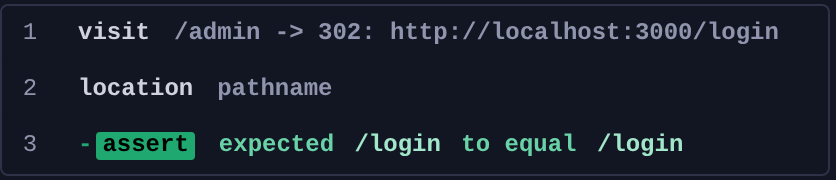
cy.visit() follows redirects and resolves on the page it ends on:
// we aren't logged in, so our web server
// redirected us to /login
cy.visit('/admin')
cy.location('pathname').should('eq', '/login')
The Command Log shows each redirect after the URL you visited, with its status code and where it led:
When cy.visit() adds the http:// protocol for you
Cypress prepends the http:// protocol to URLs that start with
localhost, 0.0.0.0, 127.0.0.1, or www., and to hosts with three or four
dot-separated parts, such as beta.example.com. For any other host, such as
example.com, provide the protocol. Otherwise Cypress treats the URL as a
relative path.
cy.visit('localhost:3000') // Visits http://localhost:3000
cy.visit('0.0.0.0:3000') // Visits http://0.0.0.0:3000
cy.visit('127.0.0.1:3000') // Visits http://127.0.0.1:3000
cy.visit('www.example.com') // Visits http://www.example.com/
How cy.visit() handles a URL that changes only the hash
When the URL you visit matches the current page except for the hash, the browser
doesn't make a new request. cy.visit() resolves on the hashchange event
instead of the load event, and onBeforeLoad is not called. If the hash is
also the same as the current one, neither onBeforeLoad nor onLoad is called.
cy.visit('/#/users')
cy.visit('/#/settings') // no page reload
Change the user agent for cy.visit()
To change the User-Agent header, see
how to override the browser's default user agent.
Intercept requests your app makes before cy.visit() resolves
A common need is to visit a page and stub the requests your app makes as soon as it starts. You might expect this to work:
// this code may not work depending on implementation
cy.visit('/#/app')
cy.intercept('GET', '/users/**', { fixture: 'users.json' })
If your app makes a request while it starts up, the code above can miss it.
cy.visit() resolves once the page fires its load event, and Cypress doesn't
process the cy.intercept() command until after
that.
By then, many apps have already begun routing, initializing, and sending requests, so the route is registered too late to catch them.
Reverse the order of the commands:
// this code is probably what you want
cy.intercept('GET', '/users/**', { fixture: 'users.json' }).as('getUsers')
cy.visit('/#/app')
cy.wait('@getUsers')
Routes you register before cy.visit() are already active when the page starts
loading, so they catch the requests your app makes as soon as it runs.
Visiting cross-origin sites with cy.visit()
After visiting a cross-origin site, interact with its content inside a
cy.origin() block.
When visiting a cross-origin site, the onBeforeLoad and onLoad options are
not supported. Instead, register a window:before:load or window:load event
listener inside a cy.origin() block for that origin, then visit it:
cy.visit('/')
cy.origin('https://auth.example.com', () => {
  cy.on('window:before:load', (win) => {
    // what you would have put in onBeforeLoad
    win.localStorage.setItem('returnTo', '/dashboard')
  })
})
cy.visit('https://auth.example.com/login')
Rules
Requirements
cy.visit()requires being chained off ofcy.cy.visit()requires the response to becontent-type: text/htmlorapplication/xhtml+xml. When the response has nocontent-typeheader, Cypress checks whether the body is HTML.cy.visit()requires the response code to be2xxor3xxafter following redirects, unlessfailOnStatusCodeisfalse.cy.visit()requires theloadevent to eventually fire, unless the visit changes only the URL's hash.
Assertions
cy.visit()automatically waits for assertions you have chained to pass.
Timeouts
cy.visit()can time out waiting for the page to fire itsloadevent.cy.visit()can time out waiting for assertions you've added to pass.cy.visit()fails with a network error if the server doesn't respond withinresponseTimeout, even whenpageLoadTimeoutis longer.
Command Log
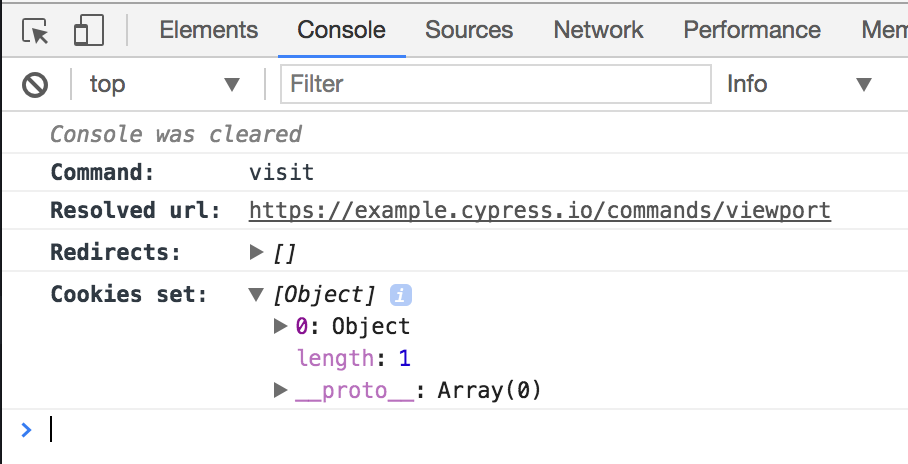
This example visits the example application in a beforeEach:
beforeEach(() => {
  cy.visit('https://example.cypress.io/commands/viewport')
})
The commands above display in the Command Log as:

When you click visit in the Command Log, the console outputs the following:
History
| Version | Changes |
|---|---|
| 14.0.0 | cy.origin() is required to visit a different origin in the same test, rather than a different superdomain |
| 11.0.0 | Removed experimentalSessionAndOrigin reference |
| 3.5.0 | Added support for options qs |
| 3.3.0 | Added support for options retryOnStatusCodeFailure and retryOnNetworkFailure |
| 3.2.0 | Added options url, method, body, and headers |
| 1.1.3 | Added option failOnStatusCode |
| 0.18.2 | Automatically send Accept: text/html,*/* request header |
| 0.18.2 | Automatically send User-Agent header |
| 0.17.0 | Cannot cy.visit() two different super domains in a single test |
| 0.6.8 | Added option log |
| 0.4.3 | Added option onBeforeLoad |
| < 0.3.3 | cy.visit() command added |