last
Get the last DOM element within a set of DOM elements.
The querying behavior of this command matches exactly how
.last() works in jQuery.
Syntax
.last()
.last(options)
Usage
Correct Usage
cy.get('nav a').last() // Yield last link in nav
Incorrect Usage
cy.last() // Errors, cannot be chained off 'cy'
cy.getCookies().last() // Errors, 'getCookies' does not yield DOM element
Arguments
options (Object)
Pass in an options object to change the default behavior of .last().
| Option | Default | Description |
|---|---|---|
log | true | Displays the command in the Command log |
timeout | defaultCommandTimeout | Time to wait for .last() to resolve before timing out |
Yields
.last()yields the last DOM element within the set it was given..last()is a query, and it is safe to chain further commands.
Examples
No Args
Get the last list item in a list
<ul>
  <li class="one">Knick knack on my thumb</li>
  <li class="two">Knick knack on my shoe</li>
  <li class="three">Knick knack on my knee</li>
  <li class="four">Knick knack on my door</li>
</ul>
// yields <li class="four">Knick knack on my door</li>
cy.get('li').last()
Assert on the newest item after adding one with .last()
A new item often renders at the end of a list after a request resolves. Chain an
assertion off .last(), and Cypress re-runs the query until the new item is the
last one and the assertion passes.
<input class="new-todo" />
<ul class="todo-list">
  <li>Buy milk</li>
</ul>
<!-- pressing Enter in .new-todo sends a request, then adds the text as a new <li> at the end of the list -->
cy.get('.new-todo').type('Write docs{enter}')
cy.get('.todo-list li').last().should('have.text', 'Write docs')
Act on the last row of a table with .last()
.last() yields a DOM element, so you can keep chaining queries and actions off
it.
<table>
  <tbody>
    <tr>
      <td>Ada</td>
      <td><button>Delete</button></td>
    </tr>
    <tr>
      <td>Grace</td>
      <td><button>Delete</button></td>
    </tr>
  </tbody>
</table>
<!-- clicking a Delete button removes its row -->
cy.get('tbody tr').last().find('td').first().should('have.text', 'Grace')
cy.get('tbody tr').last().find('button').click()
cy.get('tbody tr').should('have.length', 1)
Options
Wait longer for the last element with the timeout option
The timeout you pass to .last() sets how long Cypress retries the whole
query chain, including the cy.get() before it. Here, the second notification
appears after 6 seconds, which is past the default 4-second
defaultCommandTimeout.
<div class="notification">Saved</div>
<!-- a second .notification with the text "Synced" is added after 6 seconds -->
cy.get('.notification').last({ timeout: 10000 }).should('have.text', 'Synced')
Notes
How .last() compares to .eq(-1)
.last() yields the same element as .eq(-1). Use .eq()
to get an element at any other index, including negative indexes counted back
from the end of the set.
Selecting the last element that matches a selector
.last() takes no selector. cy.get('li').last('.active') yields the last
<li> whether or not it has the class active. The Command Log still shows
.active as the command's message, which can make it look as though the
selector was applied:

TypeScript flags the call as an error. To get the last
element that matches a selector, narrow the set with
.filter() before calling .last().
cy.get('li').filter('.active').last()
How .last() compares to the :last-child selector
.last() yields a single element, the last one in the whole set. The CSS
:last-child selector matches the last child of each parent, so it can match
several elements when the set spans more than one parent.
<ul class="fruits">
  <li>Apple</li>
  <li>Banana</li>
</ul>
<ul class="veggies">
  <li>Carrot</li>
  <li>Daikon</li>
</ul>
cy.get('li').last() // yields <li>Daikon</li>
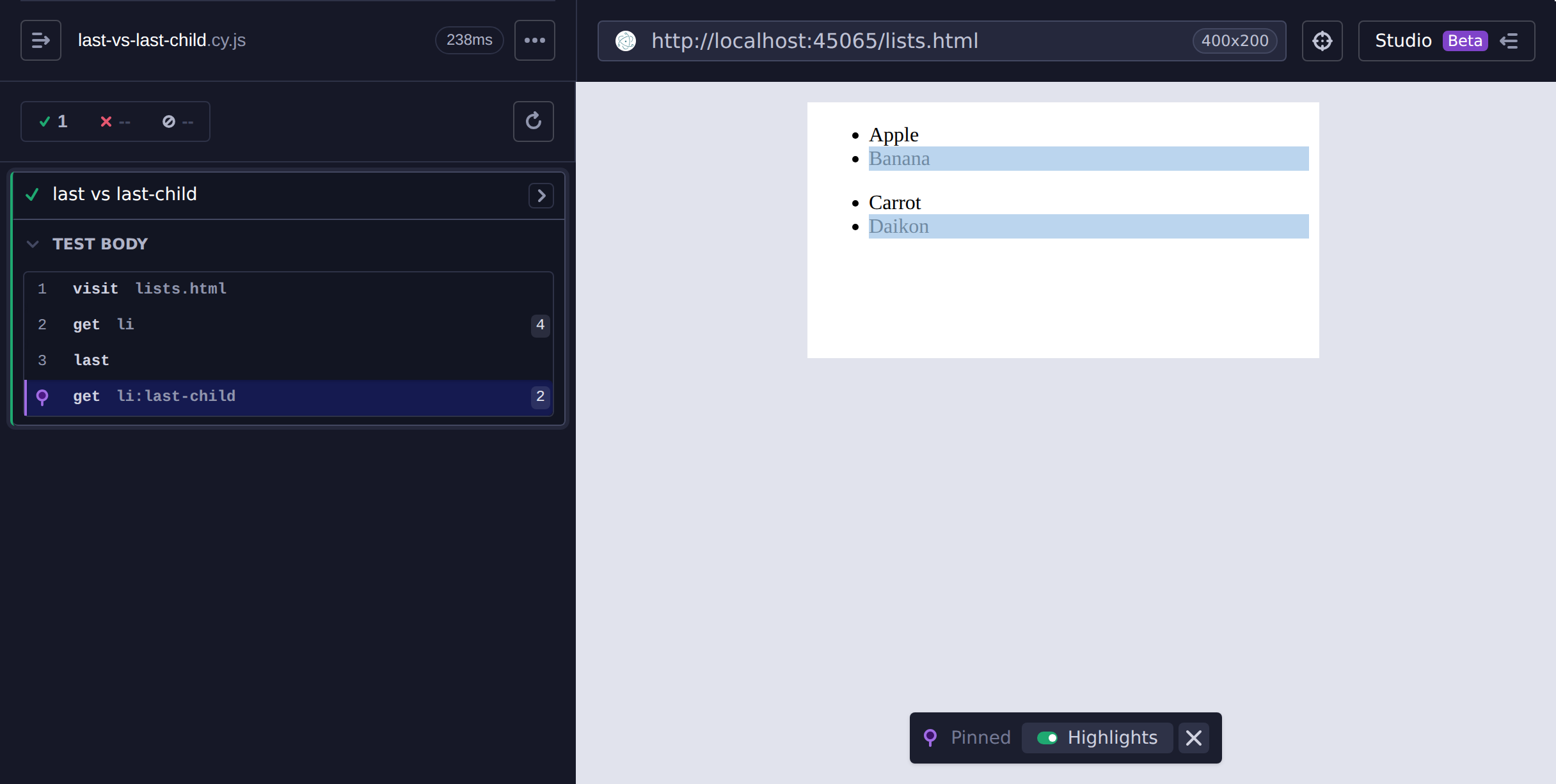
cy.get('li:last-child') // yields <li>Banana</li> and <li>Daikon</li>
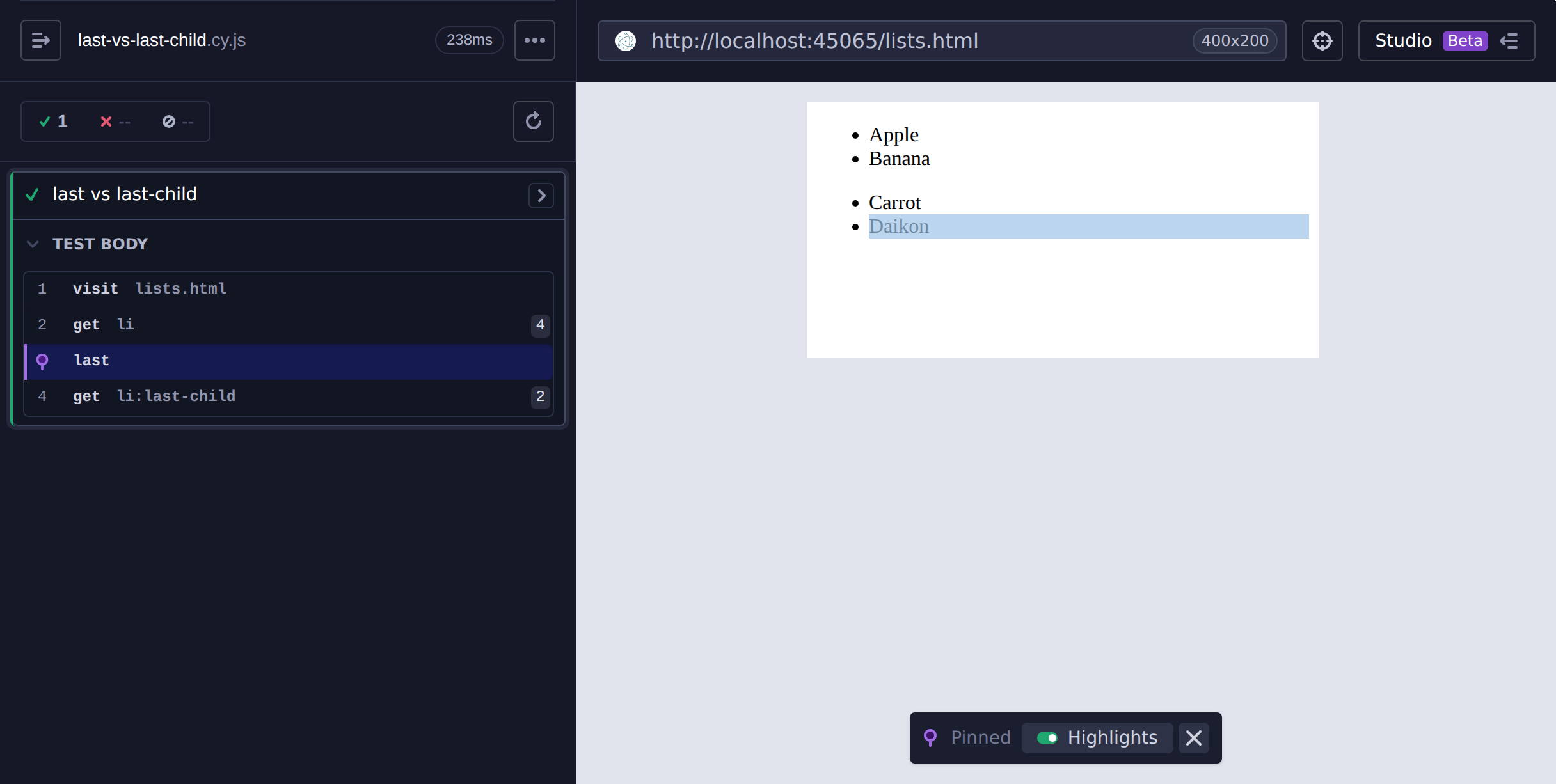
Click a row in the Command Log to pin its snapshot and highlight the elements it
yielded. Pinning last highlights only Daikon:
Pinning get li:last-child highlights Banana and Daikon, the last item in each
list:
Aliasing the result of .last()
An alias stores the query chain, not the element it found. Each time you use the
alias, Cypress re-runs the chain against the current DOM, so an aliased
.last() always yields the element that is last now. Learn more in
aliasing DOM elements.
Using the to-do list from the newest item example:
cy.get('.todo-list li').last().as('newest')
cy.get('@newest').should('have.text', 'Buy milk')

cy.get('.new-todo').type('Write docs{enter}')
cy.get('@newest').should('have.text', 'Write docs')
Rules
Requirements
.last()requires being chained off a command that yields DOM element(s) or a document.
Assertions
.last()will automatically retry until the element(s) exist in the DOM..last()will automatically retry until all chained assertions have passed.
Timeouts
.last()can time out waiting for the element(s) to exist in the DOM..last()can time out waiting for assertions you've added to pass.
Command Log
Find the last button in the form
cy.get('form').find('button').last()
The commands above display in the Command Log as:

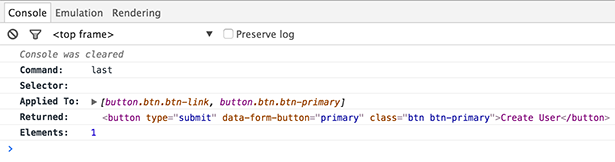
Click the last command in the Command Log to print the following to the
console:
History
| Version | Changes |
|---|---|
| 12.6.0 | Overwrite .last() with Cypress.Commands.overwriteQuery() rather than Cypress.Commands.overwrite(). |
| 12.0.0 | .last() is now a query. |