getCookie
Get a browser cookie by its name.
Syntax
cy.getCookie(name)
cy.getCookie(name, options)
Usage
Correct Usage
cy.getCookie('auth_key') // Get cookie with name 'auth_key'
Incorrect Usage
cy.getCookie() // Errors, a cookie name is required
cy.getCookie({ domain: 'example.com' }) // Errors, name must be a string
Arguments
name (String)
The name of the cookie to get. Required, and must be a string.
options (Object)
Pass in an options object to change the default behavior of cy.getCookie().
| Option | Default | Description |
|---|---|---|
domain | Hostname of the application under test | Retrieves the cookie from the specified domain |
log | true | Displays the command in the Command log |
timeout | defaultCommandTimeout | Time to wait for cy.getCookie() to resolve before timing out |
Yields
cy.getCookie() yields a cookie object with the following properties:
domain: (String)expiry: (Number) (if specified)hostOnly: (Boolean) (not always reported)httpOnly: (Boolean)name: (String)path: (String)sameSite: (String) (if specified)secure: (Boolean)value: (String)
cy.getCookie() is a query, and it is safe to chain further commands. It
re-reads the cookie on each retry, and the
assertions you chain with .should() drive those
retries. If an assertion fails, because the cookie is null or because a
property doesn't match yet, the query reads the cookie again and re-runs the
assertion until it passes or the command times out.
With no assertion chained, cy.getCookie() yields whatever it reads on the
first attempt. A .then() callback runs once and isn't
retried, so chain .should('exist') before it to wait for a cookie that your
application sets asynchronously.
When a cookie matching the name could not be found:
cy.getCookie() yields null.
Examples
Session id
The Logging In recipes use
cy.getCookie() to test logging in with HTML web forms, XHR web forms, and
single sign-on.
Get session_id cookie after logging in
In this example, your server sends back a session cookie on login.
// assume the user just logged in
cy.contains('Login').click()
cy.url().should('include', 'profile')
// retries until cookie with value=189jd09su
// is found or default command timeout ends
cy.getCookie('session_id').should('have.property', 'value', '189jd09su')
To check that the cookie exists without comparing any of its properties, assert
exist:
cy.getCookie('my-session-cookie').should('exist')
Send the session cookie's value in a request header
To pass the cookie's value to a later command, chain
.its('value') and use the value inside
.then(). Cypress runs the callback after .its()
finds the value, so cy.request() gets the current value rather than one read
when the test queued its commands.
cy.getCookie('session_id')
  .its('value')
  .then((token) => {
    cy.request({
      url: '/api/admin',
      headers: {
        'my-token-x': token,
      },
    })
  })
Check that the session cookie is removed after logout
Assert not.exist to confirm a cookie is gone. The query retries until the
assertion passes, so it waits for a logout request that clears the cookie after
a short delay.
cy.contains('Log out').click()
cy.getCookie('session_id').should('not.exist')
Assert on cookie properties from cy.getCookie()
Assert on one cookie property with .its()
.its() yields a single property of the cookie. Because
.its() is also a query, the assertion still retries cy.getCookie(), so the
test waits for a cookie that hasn't been set yet.
cy.getCookie('csrf_token').its('value').should('have.length', 32)
Check the security attributes of an auth cookie
Assert include with the attributes your server must set. The assertion passes
when the cookie has every listed property with the listed value.
cy.getCookie('session_id').should('include', {
  httpOnly: true,
  secure: true,
  sameSite: 'strict',
})
sameSite is 'lax', 'strict', or 'no_restriction' (the value for
SameSite=None), or 'unspecified' in Firefox when the cookie doesn't set one.
Check that a remember-me cookie expires in the future
expiry is the time the cookie expires, in seconds since the Unix epoch. This
example checks that a cookie lasts at least 29 more days:
const twentyNineDays = 29 * 24 * 60 * 60

cy.getCookie('remember_me')
  .its('expiry')
  .should('be.greaterThan', Date.now() / 1000 + twentyNineDays)
A cookie set without an expiry date has no expiry property, so
.its('expiry') fails for it.
Read a cookie on another domain with cy.getCookie()
Get a cookie set on a sibling API domain with domain
By default, cy.getCookie() reads cookies for the hostname of the application
under test. Pass domain to read a cookie set for a different domain, such as
an API on a sibling domain: api.example.com when your app runs on
app.example.com.
cy.getCookie('refresh_token', { domain: 'api.example.com' }).should('exist')
Validate a cy.session() login with cy.getCookie()
Check the login cookie in a cy.session() validate function
Use cy.getCookie() in the validate function of
cy.session() to confirm the login cookie is set.
Cypress saves the session's cookies again after validate passes, so a cookie
that arrives after the login click is still part of the cached session.
cy.session(
  username,
  () => {
    cy.visit('/login')
    cy.get('#username').type(username)
    cy.get('#password').type(password)
    cy.contains('Log in').click()
  },
  {
    validate() {
      cy.getCookie('session_id').should('exist')
    },
  }
)
To confirm that your server still accepts a restored session, see validating the session.
Notes
Default cookie domain before visiting a page
The domain option defaults to the hostname of the application under test.
Before cy.visit() loads a page, the application under
test is on about:blank, so Cypress uses the hostname it serves the spec from
instead (usually localhost). Pass domain explicitly to work with cookies on
another domain before visiting.
Which cookies cy.getCookie() matches by domain
cy.getCookie() looks for the cookie on the requested domain: the domain
option if you pass one, otherwise the hostname of the application under test.
It matches the same domain and any parent domain the cookie was set on, but not
a subdomain or a sibling domain. When the application under test is on
app.example.com, or you pass domain: 'app.example.com':
| Cookie set on | Yielded by cy.getCookie() |
|---|---|
app.example.com (same domain) | Yes |
example.com (parent domain) | Yes |
api.app.example.com (subdomain) | No |
api.example.com (sibling domain) | No |
Reading HttpOnly cookies with cy.getCookie()
cy.getCookie() reads cookies through the browser, so it yields cookies marked
HttpOnly, such as most session cookies. Your application's JavaScript can't
see those through document.cookie, so reading document.cookie in a test
misses them.
Why cy.getCookie() yields null
If no cookie with the name is ever found, cy.getCookie('session_id').should('exist')
fails with Timed out retrying after 4000ms: expected null to exist. Check these
causes:
- The name or domain doesn't match. See
which cookies
cy.getCookie()matches. - The cookie was set in an earlier test. With
test isolation on, Cypress clears cookies
before each test. Use
cy.session()to keep a login across tests. - The cookie arrives after a slow request. Pass a longer
timeout(see Timeouts).
Rules
Requirements
cy.getCookie()requires being chained off ofcy.
Assertions
cy.getCookie()automatically retries until all chained assertions have passed.
Timeouts
cy.getCookie()can time out waiting for assertions you've added to pass, or for the browser to return the cookie. Both waits use thedefaultCommandTimeout,4000ms by default, or thetimeoutoption, when passed.- If the application under test is on a different origin,
cy.getCookie()retries until the command times out and then fails with a cross-origin error, even when you pass thedomainoption. Run it insidecy.origin()to read cookies on that origin, or usecy.getAllCookies(), which reads cookies on every domain without that check. - If the browser returns an error before the first read succeeds,
cy.getCookie()fails right away instead of retrying.
Command Log
Get a browser cookie and make assertions about the object
cy.getCookie('fakeCookie1').should('have.property', 'value', '123ABC')
The commands above display in the Command Log as:

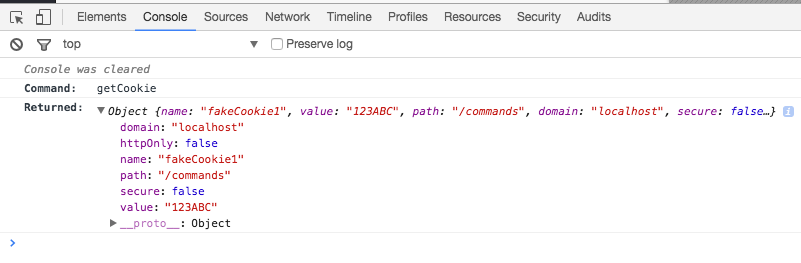
When you click getCookie in the Command Log, the console outputs the
following. When no cookie matches, the console shows null as the yielded
value, with a note that no cookie with that name was found.
History
| Version | Changes |
|---|---|
| 16.0.0 | Now a query that retries assertions, with defaultCommandTimeout as its timeout. See the Migration Guide. |
| 15.6.0 | In WebKit, prefers a cookie that matches the exact domain, falling back to a parent domain. |
| 12.0.0 | The domain option defaults to the hostname instead of the superdomain. |
| 11.0.0 | Added domain option. |
| 5.0.0 | Removed experimentalGetCookiesSameSite and made sameSite property always available. |
| 4.3.0 | Added sameSite property when the experimentalGetCookiesSameSite configuration value is true. |