getCookies
Get browser cookies for the current domain or the specified domain.
Syntax
cy.getCookies()
cy.getCookies(options)
Usage
Correct Usage
cy.getCookies() // Get cookies for the currrent domain
Arguments
options (Object)
Pass in an options object to change the default behavior of cy.getCookies().
| Option | Default | Description |
|---|---|---|
domain | Hostname of the current URL | Retrieves the cookies from the specified domain |
log | true | Displays the command in the Command log |
timeout | defaultCommandTimeout | Time to wait for cy.getCookies() to resolve before timing out |
Yields
cy.getCookies() yields an array of cookie objects. Each cookie object has the
following properties:
domain: (String)expiry: (Number) (if specified)hostOnly: (Boolean) (if specified)httpOnly: (Boolean)name: (String)path: (String)sameSite: (String) (if specified)secure: (Boolean)value: (String)
cy.getCookies() is a query, and it is safe to chain further commands. It will
automatically retry until all chained
assertions have passed, or until it times out, re-querying the list of cookies
on each retry so the yielded array stays up to date.
Because cy.getCookies() is a query, it re-reads the cookies on every retry, and
assertions you chain with .should() drive those retries
until they pass or the command times out. A .then()
callback, by contrast, runs only once after the command settles and is not
retried — so prefer chaining .should() assertions over
asserting inside .then() when you need Cypress to wait for the cookies to be
set.
When no matching cookies are present:
On each read, cy.getCookies() yields the current array of cookie objects, or an
empty array if none exist yet. The yielded array is the subject your chained
assertions run against. If an assertion fails, because the array is empty, or
because its contents don't match yet, the query re-reads the cookies and re-runs
the assertion, looping until it passes or the command times out.
Examples
Get Cookies
Get cookies after logging in
In this example, on first login our server sends us back a session cookie.
// assume we just logged in
cy.contains('Login').click()
cy.url().should('include', 'profile')
cy.getCookies()
  .should('have.length', 1)
  .then((cookies) => {
    expect(cookies[0]).to.have.property('name', 'session_id')
  })
Forward the session to another destination
cy.request() already sends the browser's cookies for
the request URL automatically, so you don't need to build a Cookie header to
call your own logged-in API. Reach for this pattern only when you need to
forward the current session somewhere Cypress won't attach cookies on its own,
such as:
- a different domain (
cy.request()only sends cookies that match the request URL) - something outside the browser, like a
cy.task()or an external HTTP client
In those cases, combine the cookies into a single Cookie header string:
cy.getCookies().then((cookies) => {
  const cookieHeader = cookies.map((c) => `${c.name}=${c.value}`).join('; ')

  cy.request({
    url: 'https://api.other-service.com/protected',
    headers: {
      Cookie: cookieHeader,
    },
  })
})
Rules
Requirements
cy.getCookies()requires being chained off ofcy.
Assertions
cy.getCookies()will automatically retry until all chained assertions have passed.
Timeouts
cy.getCookies()can time out waiting for assertions you've added to pass.
Command Log
Get browser cookies and inspect all properties
cy.getCookies()
  .should('have.length', 1)
  .then((cookies) => {
    expect(cookies[0]).to.have.property('name', 'fakeCookie1')
    expect(cookies[0]).to.have.property('value', '123ABC')
    expect(cookies[0]).to.have.property('domain')
    expect(cookies[0]).to.have.property('httpOnly')
    expect(cookies[0]).to.have.property('path')
    expect(cookies[0]).to.have.property('secure')
  })
The commands above will display in the Command Log as:
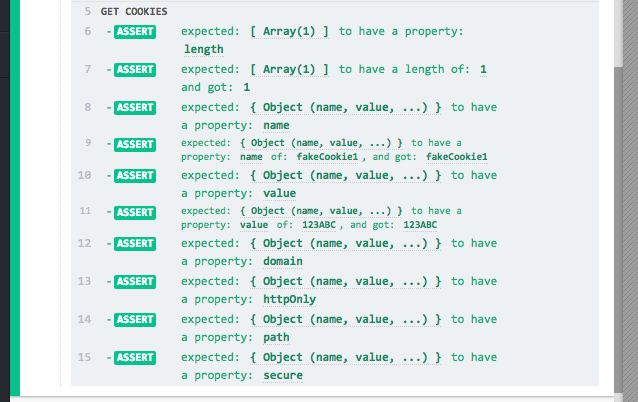
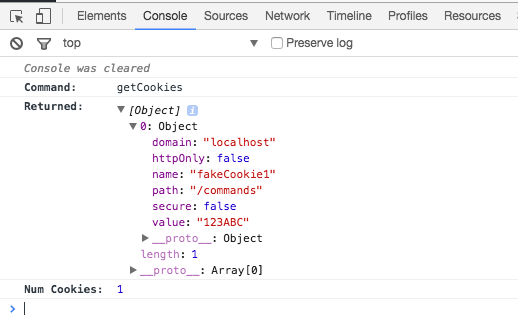
When clicking on getCookies within the command log, the console outputs the
following:
History
| Version | Changes |
|---|---|
| 16.0.0 | cy.getCookies() is now a query and retries assertions until they pass or time out. |
| 5.0.0 | Removed experimentalGetCookiesSameSite and made sameSite property always available. |
| 4.3.0 | Added sameSite property when the experimentalGetCookiesSameSite configuration value is true. |