Manage Teams and Project Access
A Cypress Cloud team is a reusable group of users that is granted access to a specific set of projects. Teams let you control project access once at the team level instead of project by project, user by user.
Teams let you shape your organization so that every person sees the projects relevant to their work, and nothing else.
Why use teams
As your organization grows, a single shared view of every project becomes harder to navigate and harder to govern. Teams solve this by aligning access in Cypress Cloud with how your organization actually works. The most valuable outcomes teams deliver are:
- A focused, clutter-free experience. Each person sees only the projects their team needs, which makes navigating Cypress Cloud faster and reduces the chance of acting on the wrong project.
- Clean separation for shared organizations. When multiple business units or subsidiaries share one Cypress Cloud organization, teams keep each unit's projects cleanly separated while preserving a single billing relationship.
- Privacy and security by default. Sensitive projects can be restricted to the specific people who should see them, so access is intentional rather than open to everyone.
- Distributed administration. The dedicated team admin role lets day-to-day team members manage their own projects, removing bottlenecks and freeing organization owners and admins from routine access requests.
- Usage insight by team. Because access is organized by team, you can understand how Cypress is used across your organization in Enterprise Reporting. This is useful for chargebacks, capacity planning, and measuring adoption.
Public projects are visible to all Cypress Cloud users, including those outside of your organization, regardless of team membership.
Manage teams
Teams are flexible by design, so you can model them to fit your organization without running into artificial limits or rigid rules. Organization owner or admin roles can create teams in Cypress Cloud. These organization owners and admins, along with a role called the team admin, are then able to configure the team as required.
This flexibility is what makes teams valuable at any scale. You can start small and expand your structure as your organization grows:
- There is no limit on the number of teams that can be set up for your organization.
- All users that are members of the organization will be a member of the default team named Everyone.
- A user can be assigned to multiple teams.
- Roles are defined at the user level. That user's role determines the permissions granted within the team.
- There is no limit on the number of projects that can be assigned to a team.
- The same project can be assigned to multiple teams.
- Team-based project access only controls what users can view in Cypress Cloud. It does not affect the ability to record runs to a project from the Cypress App.
Create a team
Only organization owner or admin roles can create teams in Cypress Cloud. Other roles will not see the button to create a new team.
-
On the Users & Teams page, select the Teams tab
-
Click + Create team

-
On the Create new team modal, enter the team name and click Save
Assign projects to a team
Project assignment is the heart of what makes teams valuable: it is the control that decides exactly which projects a team's members can see and work with. Assigning the right projects keeps each team focused on what matters to them and keeps everything else out of view.
Once a team has been created, it is important to assign projects to the team. If a team has no projects assigned to it, then a user whose only team is that team will not have access to any projects in Cypress Cloud.

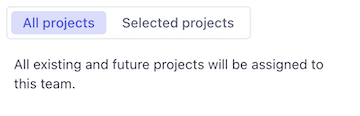
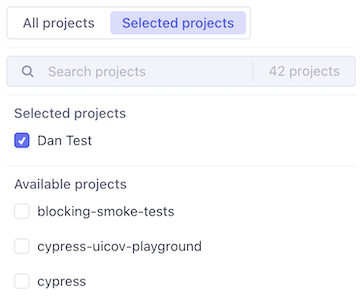
On the Teams tab, assign projects to a team by clicking the + icon in the Project access column. In the modal that appears there will be two options:
-
Assign all projects to team
Use this option if you have a team that should access all projects, including projects that already exist and ones that will be created in the future. This is the default selection for the Everyone team.
-
Assign selected projects to team
Use this option if you want to assign specific projects to a team. Search for projects by name and select (or unselect) them to assign projects to the team.
Assign users to a team
Adding users to a team is how access translates into everyday productivity: members immediately gain the right view of Cypress Cloud, and you grant that access once at the team level rather than repeating it for every project. Cypress Cloud gives you two convenient places to manage membership so you can work from whichever view fits the task at hand.
-
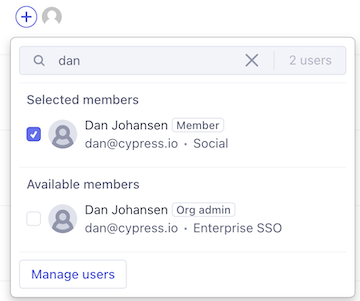
On the Teams tab, select users for a team by clicking the + icon in the Members column

This makes it easy to add multiple users to a team at the same time. Browse the user list or search by name, and then select (or unselect) them to assign users as members of this team.
-
On the Users tab, select teams for a user by clicking the + icon in the Teams column

On the edit modal, you can search by team name and then select (or unselect) them to assign the user to additional teams.
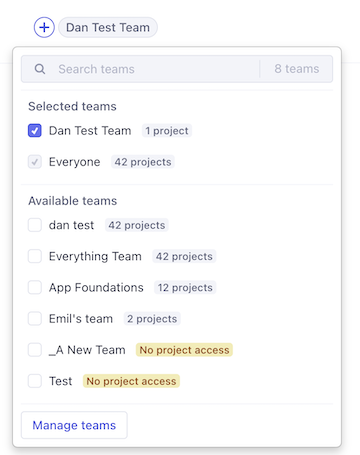
The label 'No project access' will appear if a team has not yet been configured to have access to any projects. This will help you avoid mistakes when assigning users to teams.
Delete a team
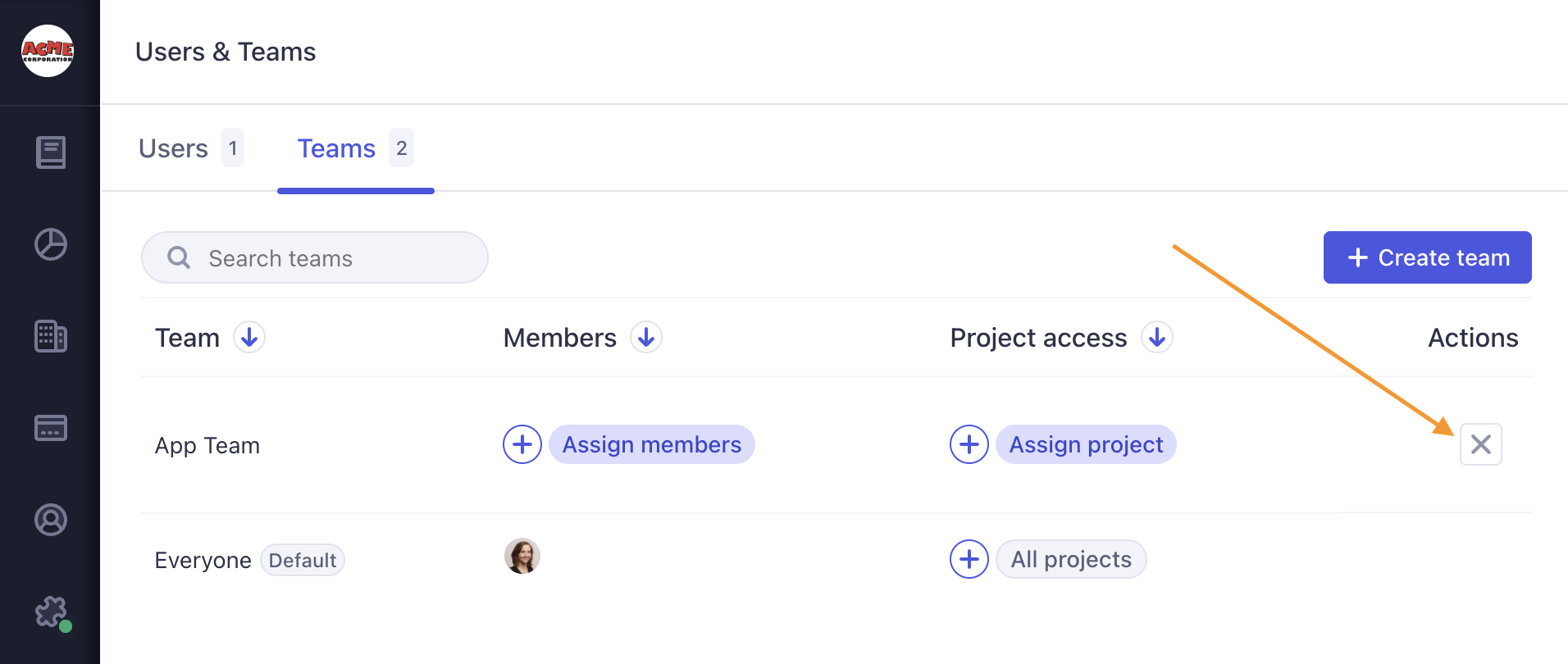
To delete a team, click on the X icon at the right side of the team's row. You will be prompted for confirmation before the team is deleted.
Example team structures
There is no single correct way to organize teams. The right shape depends on how your organization is structured and what you're trying to protect. The examples below show realistic end states that organizations commonly land on.
Product squads
A single engineering organization where each squad owns a set of repositories. Each squad sees only the projects it owns, while the Admins team retains full visibility for leadership and platform-wide debugging.
| Team | Members | Project access |
|---|---|---|
| Admins | Owners and Admins | All projects |
| Checkout | Checkout squad engineers + QA | Cart, Payments, Order History |
| Search | Search squad engineers + QA | Search API, Search UI |
| Platform | Platform/infra engineers | Design System, CI Tooling |
Multiple business units sharing one organization
A parent company or agency where several business units (or clients) share one Cypress Cloud organization but should not see each other's projects. This keeps each unit's work cleanly separated while preserving a single billing relationship.
| Team | Members | Project access |
|---|---|---|
| Admins | Owners and Admins | All projects |
| Brand A | Brand A team | Brand A web, Brand A app |
| Brand B | Brand B team | Brand B web, Brand B app |
Restricted access for sensitive projects
A mostly-open organization that needs to lock down a small number of sensitive projects. Here the broad Everyone team is kept for general projects, and a small, explicitly-managed team gates the sensitive ones.
| Team | Members | Project access |
|---|---|---|
| Everyone | All organization members | All non-sensitive projects |
| Payments | Payments engineers + auditors | Payments, Billing |
See also
- Manage users - invite users and assign roles that determine team permissions
- Manage projects - set up projects and control public vs. private access
- Manage organizations - configure org-level settings, billing, and integrations
- Enterprise Reporting - understand Cypress usage by team
- Teams FAQ - answers to common questions about teams