Billing & Usage
The Billing & Usage section of Cypress Cloud shows your current plan, what it includes, and how much your team has used in the current billing period. It is more than a receipt: it tells you whether your plan still fits how your team works, so you can upgrade before you hit a limit, attribute usage to the right projects, and see where your team is adopting AI.
Your plan meters two things that matter day to day: how many test results you can record per billing period, and the limits on AI capabilities. Test results are counted across three tiers: included, bundled, and on-demand (explained in Cloud test results). Depending on your plan, the test results allowance may be monthly or annual. Watching both here keeps the value of Cloud flowing without surprises.
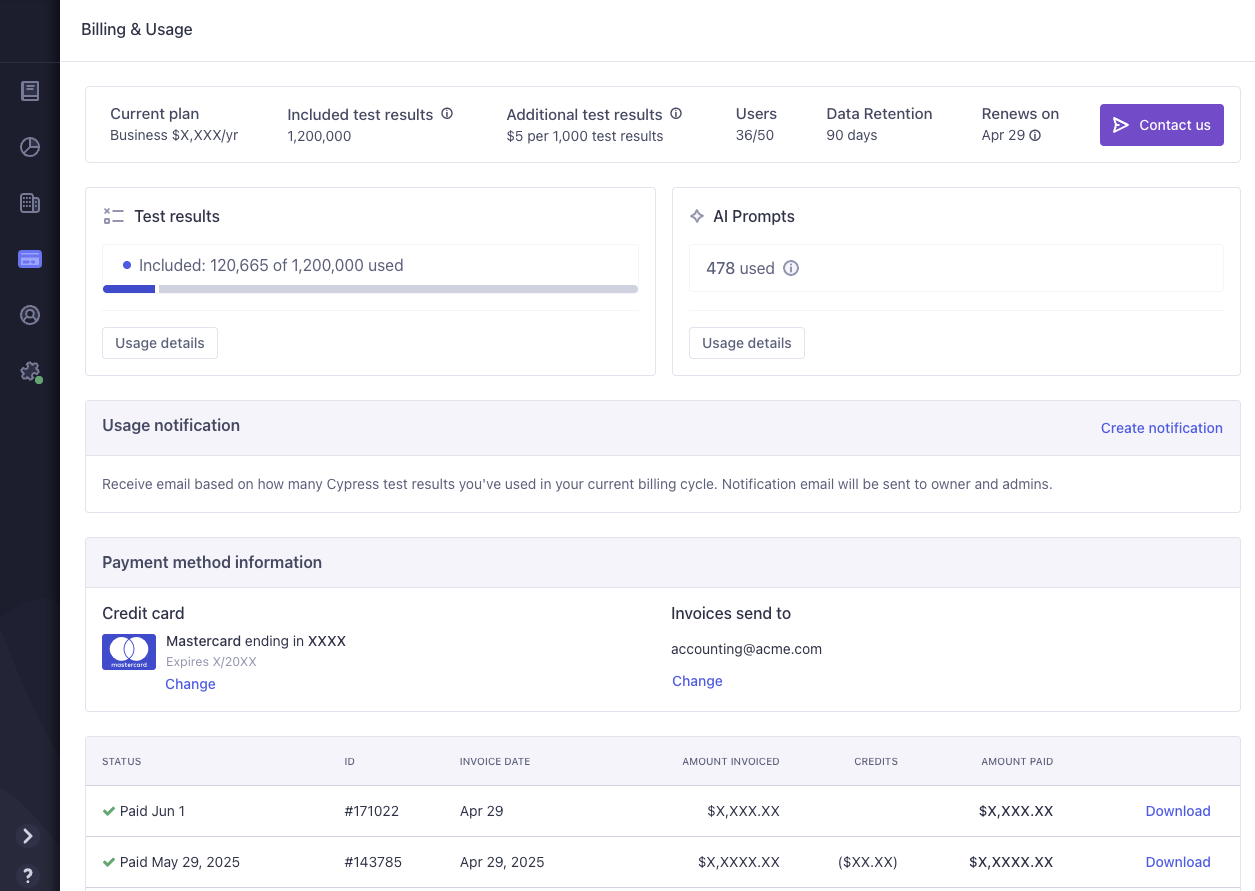
Plan overview
The card at the top of the page summarizes your subscription at a glance, so you always know what you are entitled to and when it renews:
- Current plan: your plan tier and price.
- Included test results: the number of test results included in your plan (Team, Business, etc.) each billing period.
- Bundled test results: the number of extra test results you have purchased up front, mid-term, to extend your allowance before you rely on on-demand pricing.
- On-demand test results: the per-unit price for any test results recorded beyond your included and bundled amounts, so you can anticipate these costs before they appear on an invoice.
- cy.prompt executions: how many cy.prompt executions your plan allows and how many you have used.
- Users: how many of your plan's user seats are in use. To see how many seats each plan allows, compare plans on the pricing page.
- Data Retention: how long your recorded runs and their artifacts stay available in Cypress Cloud.
- Renews on: the date your plan renews and your usage cycle resets.
Use the Subscribe, Change plan, or Contact us buttons to subscribe, upgrade, or ask questions about your plan.

Cloud test results
A test result is each passed or failed test recorded when you run cypress run --record; pending and skipped tests are not counted (see what counts as a test result). It is the core unit Cypress Cloud meters, and it is what unlocks everything Cloud does for your team. In exchange for recording, each run becomes debuggable and measurable: you get Test Replay to reproduce failures exactly as they happened in CI, Flaky Test Management to catch unreliable tests, analytics to track quality over time, and Smart Orchestration to run specs in parallel and cut CI time. Test results are the meter behind all of that value.
Cypress Cloud counts test results across three tiers, consumed in this order:
- Included: the test results included in your plan (Team, Business, etc.) for each billing period.
- Bundled: extra test results you purchase up front, mid-term, to top up your allowance before any on-demand usage begins.
- On-demand: unexpected, non-prepaid test results recorded beyond your included and bundled amounts, generally billed at a higher per-unit price point.
The Test results card highlights the number of used and included test results in your current billing period. It also shows how many bundled test results you have purchased and used, and any on-demand test results recorded beyond those amounts, if applicable.
Keeping an eye on this card matters because of what happens once you exhaust your included and bundled test results. If your plan does not allow on-demand usage, recording keeps working but parallelization is disabled and new results are hidden from the dashboard until you upgrade or the cycle resets:
| Once included and bundled test results are used | Behavior |
|---|---|
Recording (--record) | Still runs |
| On-demand test results | Recorded at a higher per-unit price, where your plan allows |
| Parallelization | Disabled if on-demand usage is not available |
| New results in dashboard | Hidden until upgrade or cycle reset if on-demand is not available |
| Usage cycle | Resets each billing period (monthly or annual) |
Reviewing usage here lets you upgrade ahead of time and avoid any interruption.
Usage over time
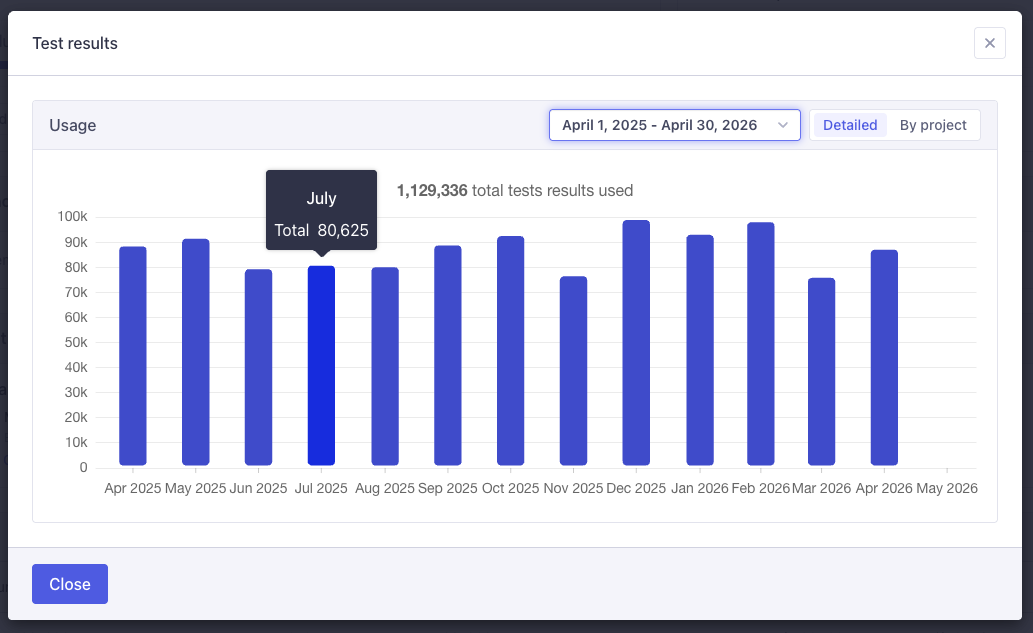
Click the Usage details button to view graphs of your test results usage.
The Detailed tab shows your usage over time during the selected billing period, broken down by included, bundled, and on-demand test results. Use it to spot trends: a steadily rising line tells you when it's time to move to a larger plan, while a sudden spike can reveal a misconfigured pipeline recording far more than you expected. A growing share of on-demand usage is a signal to consider more included or bundled test results, which are typically more cost-effective.
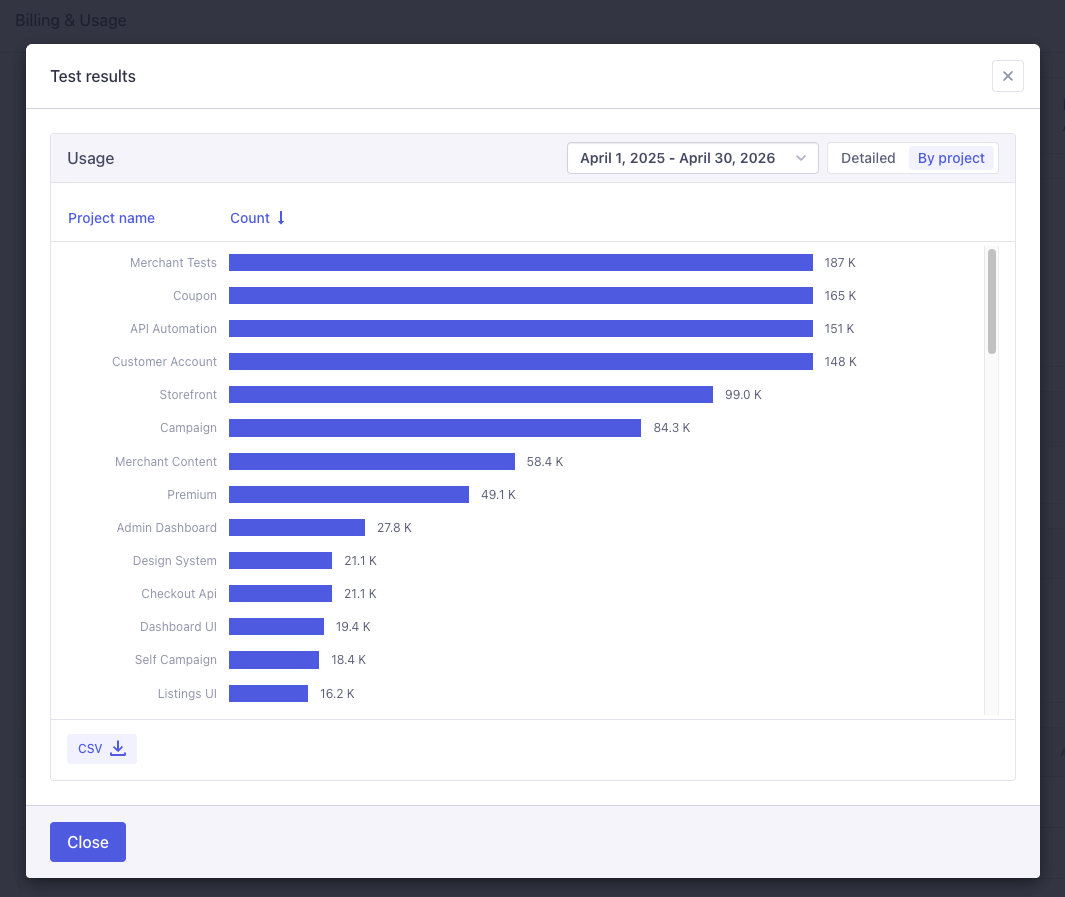
Usage by project
The By project tab shows your usage per project during the selected billing period, so you can see which projects consume the most of your plan and attribute cost back to the teams that drive it. Click the CSV button to download your results usage for chargeback reporting or further analysis.
Prompt executions
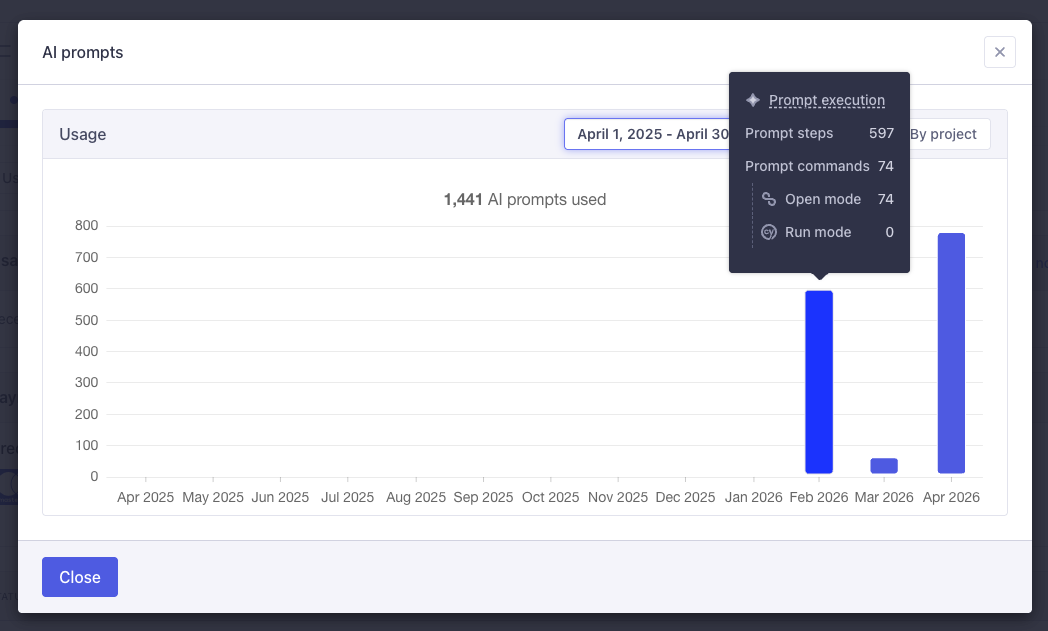
The AI Prompts card tracks cy.prompt usage in your organization for the current billing period, both the number of prompt executions and the number of steps those prompts ran. cy.prompt is the AI capability that turns natural-language steps into executable Cypress commands and can self-heal tests when selectors change. Its value is in the manual work it removes: faster test authoring from plain English, and fewer broken tests to fix when your UI evolves. This card shows you how broadly that value is being adopted across your organization.
The "Prompt execution" information conveys how many times the cy.prompt command has been executed in your organization, either on developer machines or in CI. Each cy.prompt command can define more than one step to be executed. We also break down the number of commands that took place in "Open mode" or in "Run mode". Together this tells you not just how much AI is being used, but where: whether developers are authoring tests interactively, or whether self-healing is running in CI, so you can see how your team is putting AI to work.
For limit behavior, the grace period, and what happens when you exceed your allowance, see cy.prompt in the Cloud FAQ.
Usage over time
Click the Usage details button to view graphs of your cy.prompt AI usage.
The Detailed tab shows your prompt usage over time during the selected billing period, so you can watch AI adoption grow as more of your team picks it up.
Usage by project
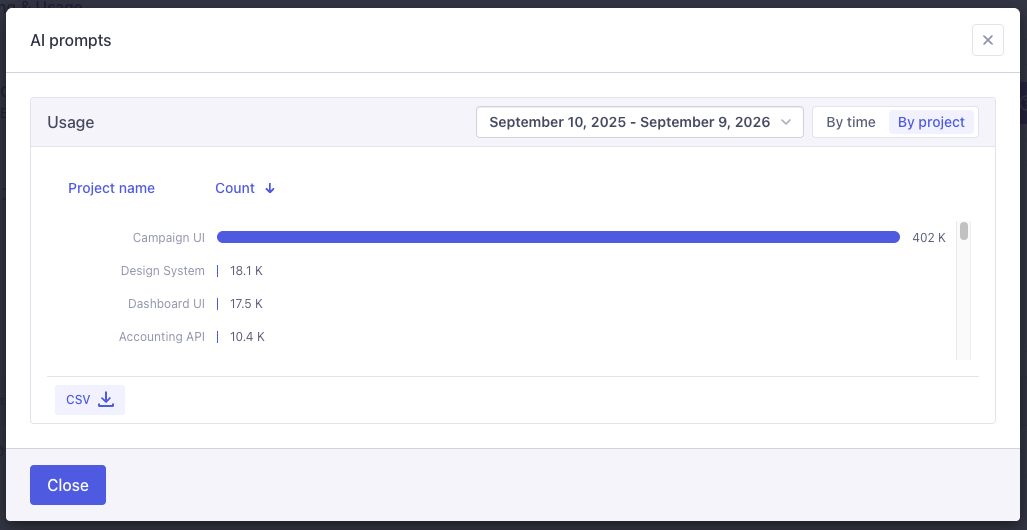
The By project tab shows your prompt usage per project during the selected billing period, surfacing which projects are getting the most out of AI-assisted testing. Click the CSV button to download your AI prompt usage for further analysis.
Usage notification
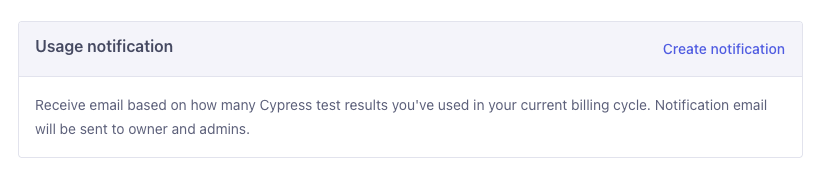
A usage notification emails your organization's owner and admins when your recorded test results reach a number you choose in the current billing cycle. Instead of remembering to check this page, you get told when you are approaching your limit, so you can upgrade or adjust before parallelization is disabled and new results are hidden. That early warning is the difference between a planned upgrade and a surprise interruption to your CI feedback, and it keeps owners and admins aware of usage trends without anyone having to monitor the dashboard manually.
From the Usage notification card, click Create notification
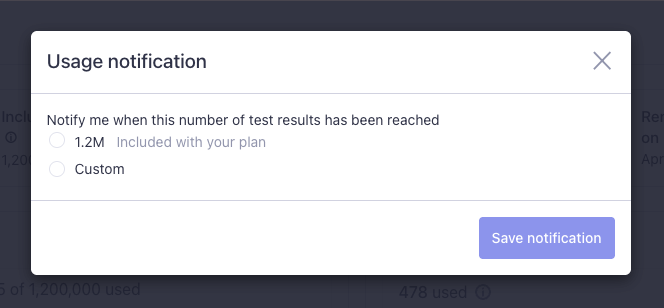
Choose the threshold that triggers the email:
- Included with your plan: notify when you reach the test results already included in your plan, so you hear about it right as you hit the ceiling.
- Custom: notify at a number you set, which is useful for getting an earlier heads-up while you still have room to act.
Click Save notification to enable it. The notification email is sent to the organization's owner and admins.
Payment method and billing email
The Payment method information card shows the credit card on file and the email address your invoices are sent to, and lets an Owner or Admin keep both current without contacting support. Keeping these accurate means uninterrupted service and invoices that reach the right inbox, so a renewal never fails because of an expired card and finance always receives the bill.
- Credit card: Click Change to update the card on file, for example when it expires or you switch to a corporate card.
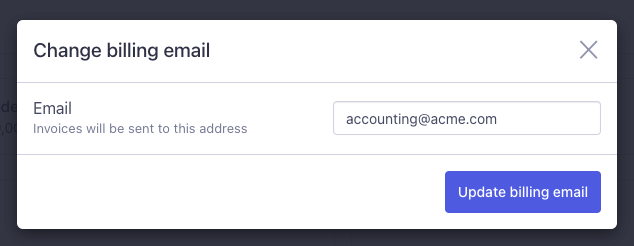
- Invoices sent to: this is the billing email address. Click Change to open the Change billing email dialog, enter the new address, and click Update billing email. Invoices and billing-related notifications are sent here, so point it at the inbox your finance or accounting team monitors.
To update other billing details, such as your billing address or company name, contact [email protected].
Invoices
Every invoice for your organization is listed at the bottom of the Billing & Usage page, giving owners and admins self-serve access to a complete billing history for expense reporting, audits, and accounting, without having to request copies from support. Each row shows the invoice status (such as Paid and the date it was paid), the invoice ID, the invoice date, the amount invoiced, any credits applied, and the amount paid.
To download a past invoice, click Download on its row. This gives you a PDF you can forward to finance or attach to an expense report at any time, including for older billing periods.

Open Source Plan
The Open Source Software (OSS) plan is a free upgrade for qualifying public, non-commercial projects. It includes 5 free users, 100k test results/month, parallelization with load balancing to keep CI fast as your suite grows, and access to numerous integrations, so open source maintainers get the orchestration and debugging power that helps commercial teams ship faster, without the cost.
To qualify, all Projects in your Organization must meet the following criteria:
- Be a non-commercial entity
- Be Public in Cypress Cloud
- Your Project source code is available in a public location with an OSI-approved license
- Record minimum of 500 tests included with the Starter Plan
Requesting OSS plan for an Organization
-
Login to the Cypress Dashboard, or create an account if you are a new user.
-
Go the Organizations page to select the Organization you want to associate with an OSS plan. If you have no Organizations, you can create one by clicking the + Create New Organization button.
-
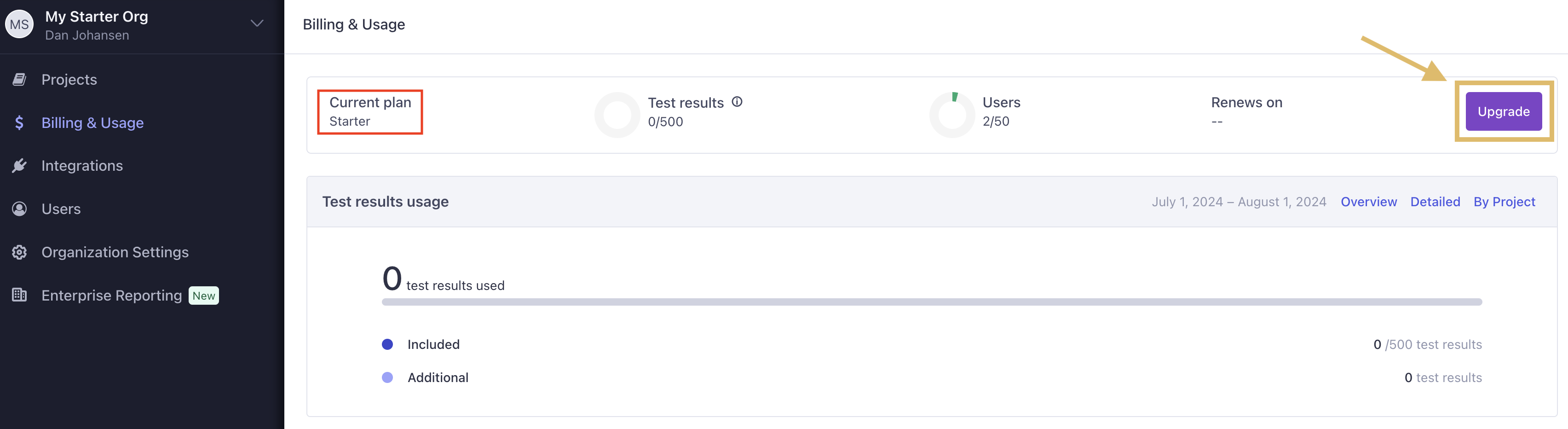
Go to the Billing & Usage page, click Upgrade and then click on the Apply for an open source plan link at the bottom of the page. Note: Access to all Projects must be set to public to enable this link.
-
Fill in and submit the OSS plan request form.
-
You'll receive an email confirming your request. The Cypress Team will review your request and, if approved, an OSS plan subscription will be applied to your Organization.
If you have any questions regarding the OSS plan, feel free to contact us.
Common billing questions
- What counts as a test result?
- What happens once I reach the test results limit?
- When does my billing period reset?
- cy.prompt usage and limits
- How do I reduce my Cypress Cloud usage or lower my bill?
- What happens if I downgrade my account?
- How much does it cost?