Ignore elements
UI Coverage tracks every interactive element your application renders during a run, including plenty you never intend to test: a third-party chat launcher, the buttons in a cookie banner, a test-only debug toolbar. Each of these counts as an untested element, drags down your score, and buries the real coverage gaps under noise you can't act on.
Excluding those elements is what makes the report trustworthy. Once the elements your team isn't responsible for are gone, every remaining untested element is a genuine decision, and your score reflects coverage of the UI you actually own. This guide walks through finding those elements and excluding them.
Excluding removes an element from the report and the score entirely, whether a
test touched it or not. If your goal is different, such as combining repeated
elements so they count as one or renaming an element, see
Which option do I need?.
To exclude whole pages instead of individual elements, use
viewFilters.
When to ignore an element
Reach for an exclusion when an untested element isn't a gap you'd ever close:
- Third-party widgets you don't control, such as chat launchers, cookie consent banners, analytics or session-replay overlays, feedback and survey popups, social share buttons, and A/B-testing toolbars. Your team isn't responsible for testing them, so they shouldn't count as gaps.
- Out-of-scope controls you've deliberately decided not to test, such as a test-only debug panel, an internal admin toggle, or a decorative control that triggers no behavior.
- Elements inside an embed you don't own, such as a payment iframe, an embedded media player, a maps widget, or a third-party sign-in form rendered in an iframe or shadow DOM.
If an element is a real part of your product that you haven't tested yet, don't exclude it. That's a gap worth keeping. See Identify coverage gaps for how to close it instead.
Step 1: Find the elements to ignore
Start from a recorded run and collect the elements that don't represent real gaps, along with a stable way to match each one. Do this in the Cypress Cloud UI, or have an AI agent shortlist candidates for you through Cypress Cloud MCP.
From the Cloud UI
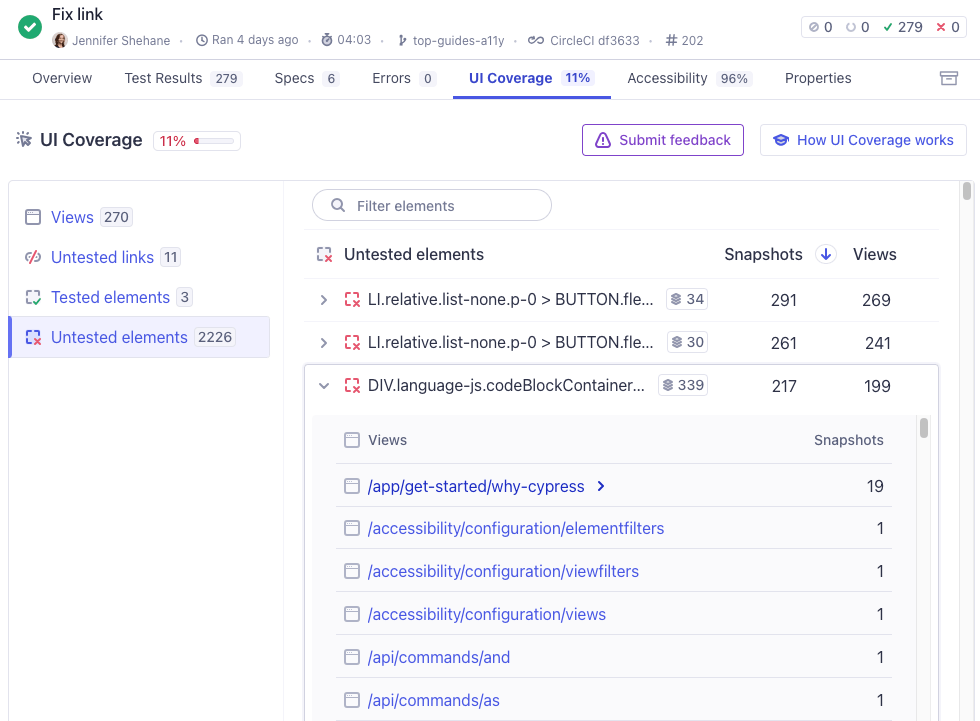
Open the run's UI Coverage tab and scan the Untested elements section for entries that don't represent real gaps:
- Look for untested elements your tests will never interact with, like the examples above.
- Expand an element to see its selector, and note a stable way to match it: an
id, adata-*attribute, a class, or a container it lives in. - Prefer a selector that matches a whole family at once (a third-party widget and everything inside it) over listing each element individually.
With an AI agent
If you use an AI coding assistant, Cypress Cloud MCP lets it pull the same report into your editor and shortlist exclusion candidates, so you can skip the manual scan. See Work with AI agents for setup and more prompts.
Find elements to ignore with your AI assistant
Shortlists untested elements worth excluding, with a suggested selector for each.
Using Cypress Cloud MCP, pull the UI Coverage report for the latest run on this branch. First, list all of the untested interactive elements. Then, from that list, give me a second list of the ones that look like third-party widgets or out-of-scope controls worth excluding, such as chat launchers, cookie banners, analytics overlays, and embeds. For each element you suggest excluding, include a stable CSS selector I can drop into an elementFilters rule to exclude it and everything inside it.
Treat the agent's list as a shortlist, not a decision: you still confirm which entries are genuinely out of scope versus a real gap before excluding them.
Step 2: Add an elementFilters rule
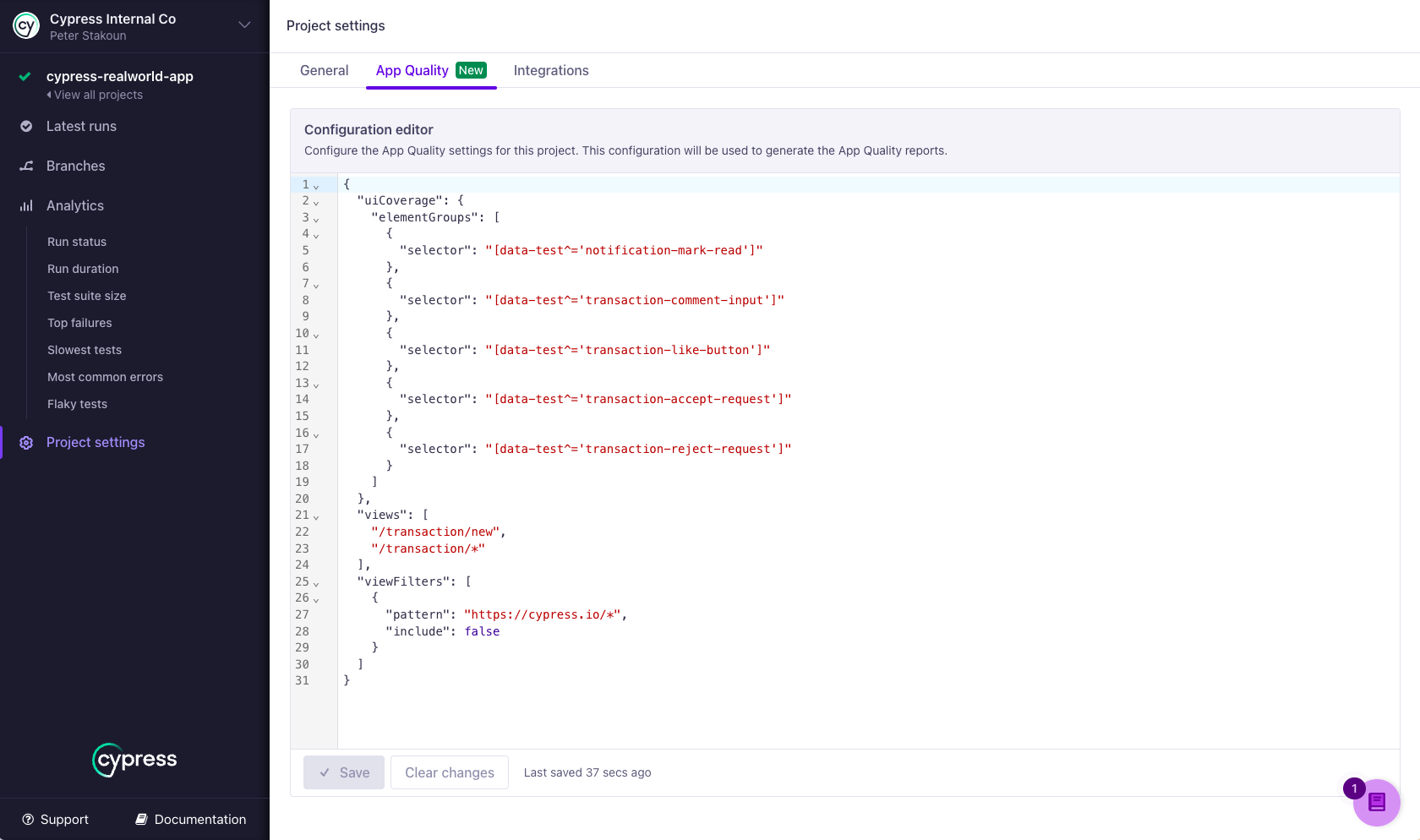
Open the App Quality tab in your project settings in Cypress Cloud and add an
elementFilters rule. Each rule
pairs a CSS selector with include: false to exclude the elements it matches.
Here, a support chat widget rendered by a third party is removed so it stops
counting as an untested element:
{
  "elementFilters": [
    {
      "selector": "#intercom-container, #intercom-container *",
      "include": false,
      "comment": "Third-party support chat, not part of our app"
    }
  ]
}
Two things decide whether a rule matches:
- The selector must match the interactive elements themselves, not just a
container around them. A rule with the selector
#intercom-containermatches only that one<div>, not the buttons inside it. To exclude everything within a container, include its descendants with a descendant selector such as#intercom-container *, as above. - The first matching rule wins. Rules are evaluated top to bottom, and each element is decided by the first rule whose selector matches it. List specific rules before general ones.
Exclude everything inside an iframe or shadow DOM
Third-party embeds often render inside an iframe or shadow DOM. Pair a wildcard
selector with documentScope to remove the entire embed at once. The
documentScope selector matches the iframe or shadow-DOM host in its parent
document:
{
  "elementFilters": [
    {
      "selector": "*",
      "include": false,
      "documentScope": ["iframe[title='Secure payment']"],
      "comment": "Embedded third-party payment form"
    }
  ]
}
For content nested more than one level deep, list one selector per host from
outermost to innermost. See the
documentScope reference
for details.
Keep specific elements out of a broad exclusion
Because the first matching rule wins, an include: true rule placed before a
broader exclude rule protects the elements it matches. This is useful when a
third-party container also holds elements you do want to test, such as your own
navigation links inside a vendor toolbar:
{
  "elementFilters": [
    {
      "selector": "nav a",
      "include": true,
      "comment": "Keep our nav links despite the vendor exclusion below"
    },
    {
      "selector": "[data-vendor] a",
      "include": false,
      "comment": "Ignore links rendered by the vendor toolbar"
    }
  ]
}
On its own, an include: true rule changes nothing, since everything is included
by default. It only matters as an exception ordered ahead of an exclude rule. For
the full evaluation model, see
How are elementFilters rules applied?.
Setting elementFilters at the root of your configuration affects both UI
Coverage and Cypress Accessibility. To exclude elements for UI Coverage only,
nest the property under a uiCoverage key. Note that include: true exceptions
have no effect in Cypress Accessibility. See
Scope.
Exclude an area for your team's runs only
A root-level rule changes the report for everyone. When several teams share one Cypress Cloud project, that's often too broad: an area that's noise for your team may be exactly what another team is responsible for testing. Excluding it at the root would erase it from the other team's report too.
Use a profiles override to scope the
exclusion to your own runs. A profile applies its config only to runs recorded
with a matching --tag,
so your team tags its runs and gets a report that drops what it doesn't own,
while every other team's runs keep the base configuration.
For example, the Account team doesn't own the support-chat widget, so its runs exclude it, but the Support team's runs (and the default report) still count it:
{
  "elementFilters": [
    {
      "selector": "#analytics-overlay, #analytics-overlay *",
      "include": false,
      "comment": "Analytics overlay, noise for every team"
    }
  ],
  "profiles": [
    {
      "name": "aq-config-team-account",
      "config": {
        "elementFilters": [
          {
            "selector": "#analytics-overlay, #analytics-overlay *",
            "include": false,
            "comment": "Repeat base rules — a profile replaces the base list, it doesn't merge"
          },
          {
            "selector": "#support-chat-widget, #support-chat-widget *",
            "include": false,
            "comment": "Account team doesn't own support chat, so it isn't a gap for us"
          }
        ]
      }
    }
  ]
}
The Account team records with the matching tag, and only those runs pick up the extra exclusion:
cypress run --record --tag "aq-config-team-account"
A profile's elementFilters replaces the base list rather than merging with
it, so repeat every base rule the tagged run still needs, as the example does for
the analytics overlay. See
profiles for merge behavior and how a
tag selects a profile.
Exclude elements from your markup instead
When the team that owns the markup also owns the decision to exclude an element,
you can do it in application code instead of Cloud configuration. Add
data-cy-ui-interactive="exclude"
to a single element, or data-cy-ui-interactive="exclude-all" to a container to
also exclude everything inside it:
<!-- Excludes just this button -->
<button data-cy-ui-interactive="exclude">Debug</button>

<!-- Excludes the toolbar and every control inside it -->
<div data-cy-ui-interactive="exclude-all">
  <button>Reset state</button>
  <button>Seed data</button>
</div>
Prefer elementFilters when you want to manage exclusions centrally in Cypress
Cloud without changing application code, or when the team that manages
configuration isn't the team that owns the markup.
Step 3: Validate the result
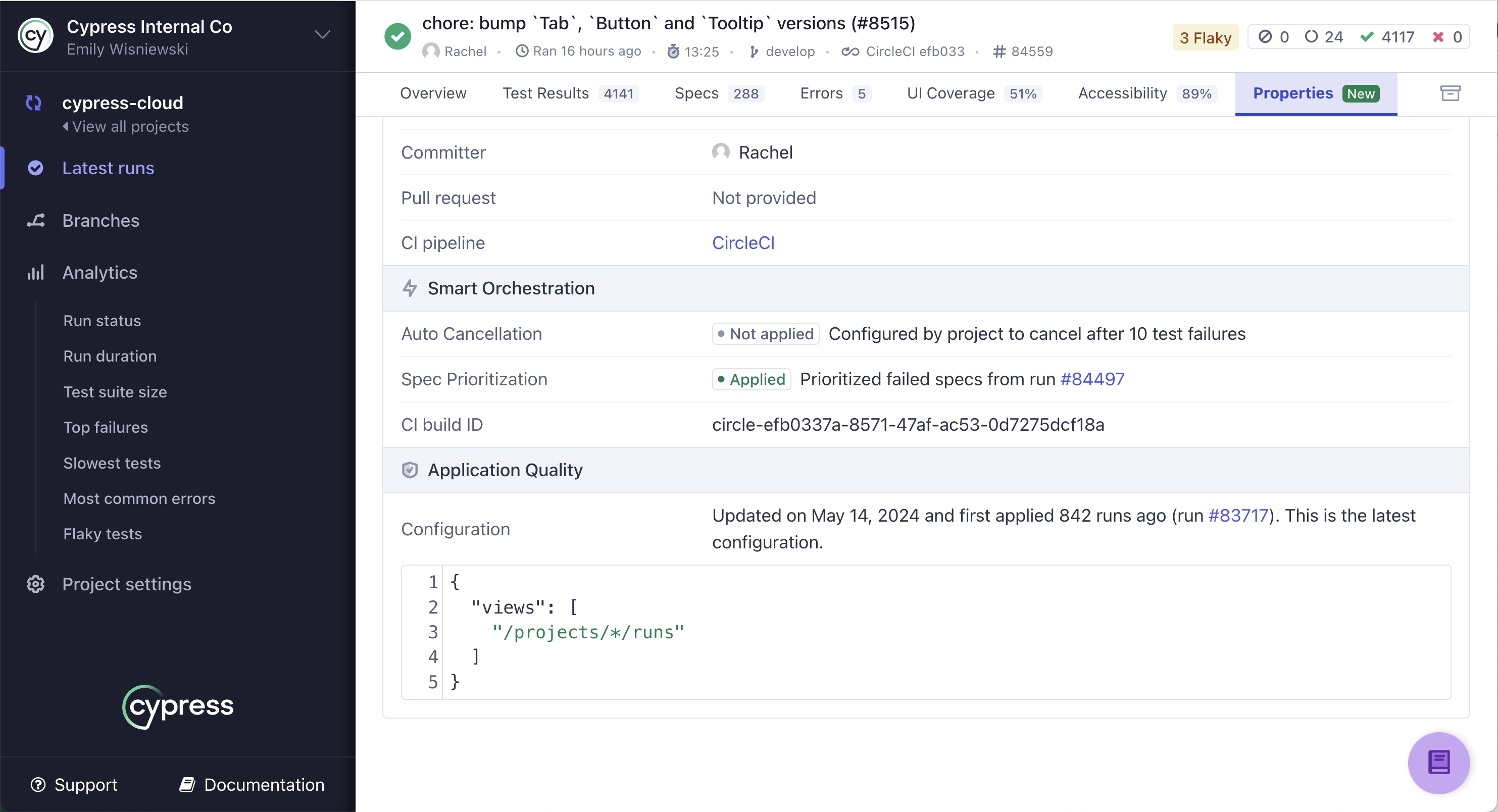
After saving, you don't need to rerun your tests. Open a recent run, go to its Properties tab, and use the regenerate button to reprocess it with your new configuration. In the regenerated report, confirm that:
- The excluded elements no longer appear in the Untested elements list.
- Your coverage score reflects only the elements you intend to test.
If an element you excluded still appears, see Why isn't my elementFilters rule excluding an element?. As your application grows, new third-party or out-of-scope elements may show up; update your filters when they do to keep reports actionable.
See also
elementFiltersconfiguration: the full reference for options, rule ordering, and validation.- Ignore views and links: exclude entire pages, and the links pointing to them, with
viewFilters. - Reduce noise: consolidate repeated elements and stabilize dynamic identities instead of removing them.
profilesconfiguration: apply a different set of exclusions per run tag, so shared projects can report per team.- Identify coverage gaps: find the real gaps that remain once the noise is gone.
- Interactivity: which elements UI Coverage tracks, and the
data-cy-ui-interactivemarkup attribute. - Configuration overview: where to set configuration and how to regenerate reports.
- UI Coverage FAQ: common questions about excluding elements and scores.