Exclude elements - elementFilters
The elementFilters configuration ignores elements in your Cypress Accessibility report. An ignored element's failed and incomplete checks stop counting against your views and your accessibility score, and the element appears under an Ignored status instead, so you can always audit what your configuration ignores.
By default, Cypress Accessibility reports on every element that Axe Core® checks in your application during your tests, including elements you can't fix: a third-party chat widget, an embedded cookie banner, content rendered by a library you don't control. Failures in those elements obscure the failures your team can act on. An elementFilters rule moves them out of the way, so your report and score reflect the accessibility of the application you own.
Why use elementFilters?
- Ignore third-party components: Chat widgets, cookie banners, embedded media players, and other elements rendered by libraries or services you don't control can be ignored, since your team can't fix their violations.
- Ignore out-of-scope elements: Remove test-only controls or areas of the application that are outside the scope of your accessibility work.
- Keep the score meaningful: A score that only reflects elements you can fix makes progress and regressions easier to see and act on.
Ignoring an element ignores all accessibility results for that element. To keep an element in your report but ignore specific rules for it, use the data-a11y-ignore attribute instead. To ignore entire pages, use viewFilters.
Scope
Note: setting elementFilters at the root of your configuration impacts both Cypress Accessibility and UI Coverage reports. To configure the products separately, nest the property under an accessibility or uiCoverage key. A nested elementFilters completely replaces a root-level one for that product; the two lists are not merged.
Setting elementFilters
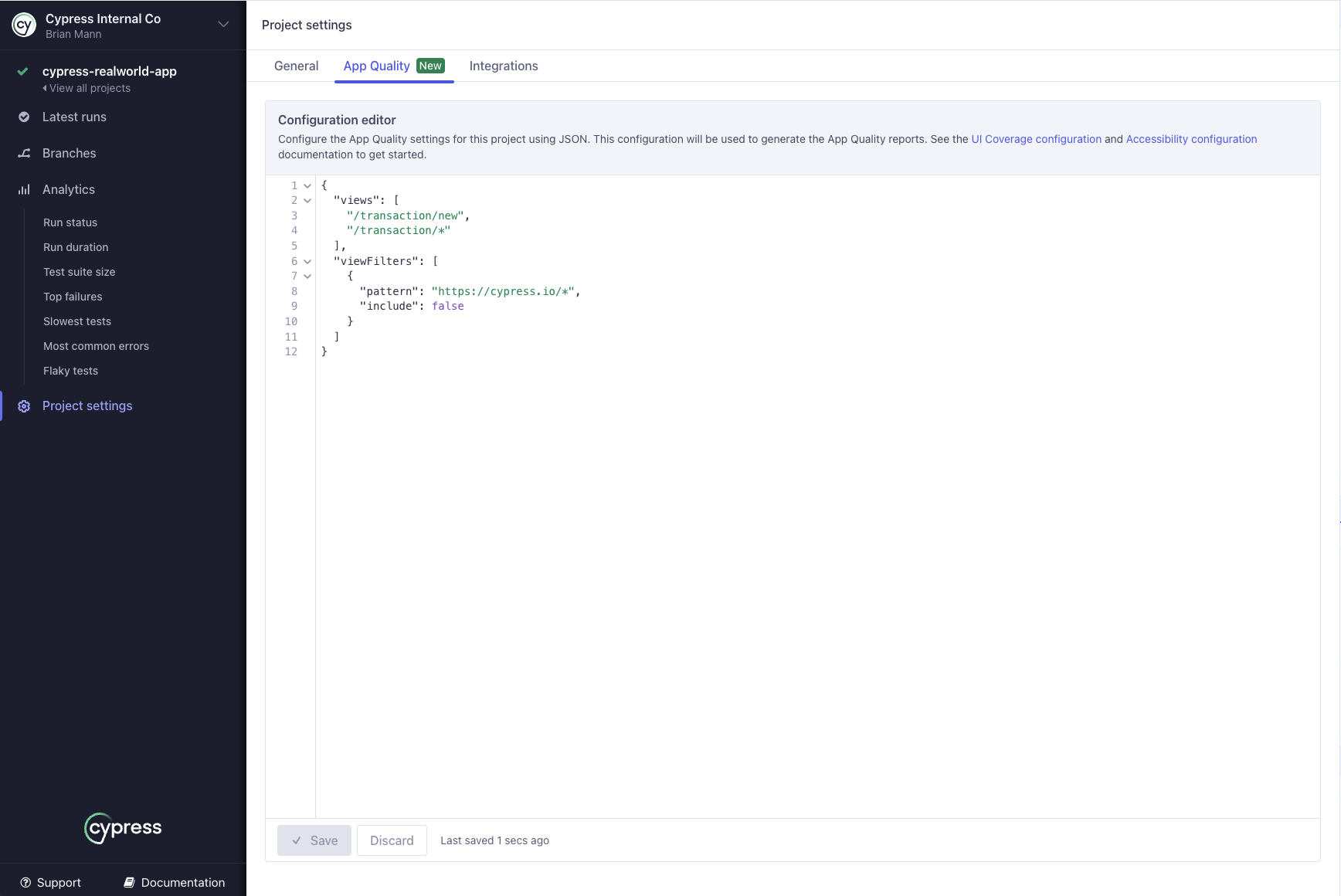
To add or edit elementFilters, open the App Quality tab in your project settings in Cypress Cloud. See Setting configuration for details, including how to regenerate past reports with a new configuration without rerunning your tests.
Syntax
{
  "elementFilters": [
    {
      "selector": string,
      "include": boolean,
      "documentScope": [string],
      "comment": string
    }
  ]
}
To apply rules to Cypress Accessibility only, nest the property under the accessibility key:
{
  "accessibility": {
    "elementFilters": [
      {
        "selector": string,
        "include": boolean
      }
    ]
  }
}
Options
| Option | Required | Default | Description |
|---|---|---|---|
selector | Required | A CSS selector that matches the elements to ignore. Supports standard CSS selector syntax, including IDs, classes, attributes, combinators, and functional pseudo-classes like :has(). The selector must match the element with the accessibility result itself, not just a container around it. | |
include | Required | Whether elements matched by this rule appear as normal results in the report. Use false to ignore the matched elements. In Cypress Accessibility, true has no additional effect, because every element is included unless an exclude rule matches it. See When to use include: true. | |
documentScope | Optional | An ordered array of CSS selectors that match document hosts (iframes or shadow DOM hosts) in the element's ancestor chain, from outermost to innermost. Use this to limit a rule to elements inside a specific iframe or shadow DOM. Hosts that aren't listed may appear between the ones that are. | |
comment | Optional | A note about why this rule exists, for your team's benefit. Comments appear only in the configuration itself. They have no effect on filtering and are not displayed in reports. |
How are elementFilters rules applied?
- Any matching exclude rule ignores the element. An element is ignored when any rule with
include: falsematches it, regardless of where the rule appears in the list. Elements that no exclude rule matches stay in the report as normal results. - An
include: truerule cannot protect or restore an element. An include rule doesn't shield its elements from exclude rules elsewhere in the list. - The selector must match the element itself. Accessibility results are reported per element, and each rule is evaluated against those elements using standard CSS matching. A rule with the selector
footerignores results on the<footer>element only, not on the elements inside it. To ignore a whole region, match the container and its descendants:footer, footer *. - Ignored elements stay visible in the report. Elements with failed or incomplete checks that your configuration ignores appear under the Ignored element status rather than disappearing, so the report always shows what your configuration is hiding. They don't count as failed or incomplete elements, and they don't affect the accessibility score.
- The score changes once every failing element of a rule is ignored. The accessibility score weighs each failed rule per snapshot, not each failing element. Ignoring some, but not all, of a rule's failing elements in a snapshot doesn't change that snapshot's score; the rule stops counting against the snapshot when all of its failing elements there are ignored.
- Ignoring an element ignores all of its results. An
elementFiltersrule applies to every accessibility rule for the matched element. To ignore only specific rules for an element, use thedata-a11y-ignoreattribute in your application code. - Rules match in any document unless scoped. A rule without
documentScopecan match elements in the main document, in iframes, and in shadow DOMs. AdddocumentScopeto restrict a rule to one of those documents.
If a rule doesn't seem to take effect, see Why is an element still failing in Cypress Accessibility after I added an elementFilters rule? in the Cypress Accessibility FAQ.
Validation rules
Cypress Cloud rejects a configuration when:
- Two rules have the same
selector(with the samedocumentScope). - A rule is missing
selectororinclude. - A
selectorordocumentScopeentry isn't valid CSS selector syntax. - A rule contains a property other than the four listed above.
Examples
Ignore a third-party widget
The selector matches both the widget's container and everything inside it, so results on the container itself are ignored along with results on its contents.
Config
{
  "elementFilters": [
    {
      "selector": "#chat-widget, #chat-widget *",
      "include": false,
      "comment": "Vendor chat widget, accessibility issues reported upstream"
    }
  ]
}
HTML
<body>
  <main>
    <button id="checkout">Check out</button>
  </main>
  <div id="chat-widget">
    <button class="chat-open">Chat with us</button>
  </div>
</body>
Result
Violations on #checkout are reported as failures. Violations on the chat widget and its contents appear under the Ignored status and don't affect the score.
Ignore elements by attribute
Config
{
  "elementFilters": [
    {
      "selector": "[data-vendor]",
      "include": false
    }
  ]
}
HTML
<body>
  <button id="save">Save</button>
  <button data-vendor="analytics">Feedback</button>
</body>
Result
Violations on #save are reported as failures. Violations on the data-vendor button appear under the Ignored status.
Ignore dynamic elements by pattern
Attribute prefix, suffix, and substring selectors ([class^='...'], [class$='...'], [class*='...']) are useful when class names or IDs are partially generated.
Config
{
  "elementFilters": [
    {
      "selector": "[class^='ext-embed']",
      "include": false
    }
  ]
}
HTML
<body>
  <button class="cancel">Cancel</button>
  <div class="ext-embed-90283" role="button">External content</div>
</body>
Result
Violations on .cancel are reported as failures. Violations on the embed appear under the Ignored status.
Ignore elements inside a shadow DOM or iframe
Use documentScope to limit a rule to elements inside a specific shadow DOM host or iframe. Here, the button inside the <custom-component> shadow root shares its id with a button in the main document. The scope restricts the rule to the shadow DOM, so results on the button in the main document are still reported.
Config
{
  "elementFilters": [
    {
      "selector": "#my-button",
      "include": false,
      "documentScope": ["custom-component"]
    }
  ]
}
HTML
<body>
  <button id="my-button">Button Outside Shadow DOM</button>
  <custom-component>
    #shadow-dom
      <button id="my-button">Button Inside Shadow DOM</button>
  </custom-component>
</body>
Result
Violations on the button in the main document are reported as failures. Violations on the button inside the shadow DOM appear under the Ignored status.
documentScope works the same way for content that renders inside an iframe. The scope selector matches the iframe element itself in its parent document, and a wildcard selector ignores everything the iframe contains:
{
  "elementFilters": [
    {
      "selector": "*",
      "include": false,
      "documentScope": ["iframe[title='Support']"]
    }
  ]
}
For nested documents, list one selector per host from outermost to innermost. For example, "documentScope": ["#my-iframe", "custom-component"] scopes a rule to a shadow DOM component rendered inside an iframe.
When to use include: true
For rules that only affect Cypress Accessibility, there's no reason to write include: true. Every element is included unless an exclude rule matches it, and an include rule can't override an exclusion.
The value exists for elementFilters lists defined at the root of your configuration, which are shared with UI Coverage. In UI Coverage, the first matching rule wins, so an include: true rule placed before a broader exclude rule keeps its elements in UI Coverage reports. Cypress Accessibility reads the same list but treats the include rule as inert.
Config
{
  "elementFilters": [
    {
      "selector": "nav a",
      "include": true,
      "comment": "Keep nav links in UI Coverage despite the vendor exclude below"
    },
    {
      "selector": "[data-vendor] a",
      "include": false,
      "comment": "Ignore links rendered by the vendor toolbar"
    }
  ]
}
HTML
<body>
  <nav data-vendor="toolbar">
    <a href="/home">Home</a>
  </nav>
  <div data-vendor="promos">
    <a href="https://vendor.example">Sponsored</a>
  </div>
</body>
Result
The Home link matches both rules. In Cypress Accessibility, the exclude rule ignores it anyway, so results on both links appear under the Ignored status. In UI Coverage, the first matching rule wins, so the Home link stays in the report while the sponsored link is excluded.
To get different outcomes per product, nest a separate elementFilters list under each product key instead of sharing one root-level list.
After saving configuration changes, regenerate a recent run to preview the effect of your rules without rerunning your tests. See Setting configuration for how to regenerate a report.
See also
data-a11y-ignore: ignore specific rules for an element instead of the whole element.viewFilters: ignore entire pages.- Run-level reports: where ignored elements appear in your report.
- Accessibility score: how the score is calculated.
- Configuration overview: where to set configuration and regenerate reports.
- Cypress Accessibility FAQ: common questions and troubleshooting.